Category Archives: Historical Fiction

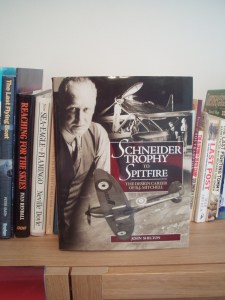
‘Schneider Trophy to Spitfire’ by John Shelton

Schneider Trophy to Spitfire by John Shelton

I bought a copy of John Shelton’s comprehensive reference book ‘Schneider Trophy to Spitfire‘ when visiting the RAF Museum in Hendon. With its chronological factual information, enhanced by original photographs, diagrams, adverts and anecdotes, it a an extremely readable history of early flying boats leading to the development of the Spitfire. Looking at the double page photo of Flt Lt B.D Hobbs in his Supermarine Sea Lion in the sea at Bournemouth is so clear, although black and white, that it looks as if it could have been taken yesterday and not in 1919.

My specific interest in reading background for my novel Ancasta Guide me Swiftly Home was only up until 1920, but with my family connections with Supermarine Woolston, with both my uncle and grandfather working there at the start of WW2, I was compelled to read it to the end.

RJ Mitchell was an amazing man with a vision for the future.  His engineering skills in designing the first flying boats and then sea planes, culminating in the Supermarine Rolls Royce S.6B winning the Schneider Trophy outright in 1931 over the Solent was an inspiration. John Shelton’s knowledge on the subject and his extensively detailed and meticulous research  has produced a volume which would be enjoyed by any person interested in history, especially that of flight.

I was able to refer to ‘Schneider Trophy to Spitfire’ on two occasions recently away from the context of my writing. One was the question posed, ‘When were metal rather than wooden hulls introduced?’

(John Shelton discusses in detail the Napier ‘Lion’  engine which could be supplied with either a metal or wooden hull in the ‘Southampton’ which appeared in March 1925)

The second was, ‘The Schneider Trophy winner was a sea plane, or float plane. When did the design suddenly change from flying boats?’

(Again Shelton describes the Supermarine Napier S4 ‘designed in an inspired moment… the greatest credit is due to RJ Mitchell for his courage in striking out on entirely new lines……..((from ‘Flight’)) and was first flown by Biard in 1925)

Supermarine’s Chief Designer was only 29 years old at the time and it must have been quite revolutionary for its day!

It was not until a recent visit to Solent Sky, the air museum in Southampton, when I looked at an exhibit of small model aircraft in the upper gallery that I could see even more clearly the development from the Schnieder Trophy to the Spitfire. Once the S4 had been established, and the world record in speed had been gained, it was not such a big leap to develop a sleek, fast and enduring landplane, the Type 224 Spitfire which is on display in Hendon today.

As a writer of historical fiction, you need to read around your subject in depth in order to weave the lives of your characters around the facts in certain moments in time so that the story is natural and believable. I would like to thank John for writing such a readable and interesting account, the fact that some of it went way beyond my technical understanding was irrelevant and I can highly recommend his book.
Leave a comment

Filed under Book reviews, Early Flight, Flying Boats and Sea Planes, Historical Fiction, Schneider Trophy, Southampton, Supermarine

A ‘Bookiful’ Weekend of Events!

If you have not been lucky enough to have tickets for the Olympics and you want a change from watching events on the TV then come along and say hello at one of my fun events next weekend.

1. ‘Bookiful’ Event Number One!

WHEN? Friday 3rd August at 7.30 pm, pray for a fine evening please!

WHERE? Weston Shore Southampton,

Meeting near the Pitch and Put – No firing golf balls in our direction please!!!!

WHAT? Book reading and Picnic.  A relaxing time to listen to appropriate extracts of my two novels Riduna and Ancasta Guide me Swiftly Home, a little talk and amusing anecdotes, followed by plenty of time for a chat and some wine. 

I have watched many a ship, ferry, sailing boat or cruise liner sail along Southampton Water from Weston Shore over the years, especially when I was a child and so, for me and my characters, Weston Shore represents emotions stirred by loss, yearning and hopefulness!

For more information visit the Weston Shore Society Blog

2. ‘Bookiful’ Event Number Two!

WHEN? Saturday 4th August 11.00 to 12.30

WHERE? The Herald Offices, High Street, Hythe (Not to be confused with Hythe in Kent, this is just over Southampton Water)

WHAT? Book signing event and saying hello

We will enjoy a trip over on the Hotspur from Southampton in the morning to reach the pier and little train (if we are feeling lazy) or walk through Hythe to the High Street

3. ‘Bookiful’ Event Number Three!

WHEN? Saturday 4th August 13.00 to 14.30

WHERE? Spinnakers Bar on Calshot Spit

WHAT? Book signing event and saying hello 

A group of us will enjoy a meal here but I will be happy to have a chat and sign books. An excellent place to have a spot of lunch or just a drink, then enjoy the fantastic views of the Solent as Southampton Water breaks free! A place seeped in history for the RNAS, the Schneider Trophy and memories for some of the Sunderland taking off towards the end of WW2.

4. ‘Bookiful’ Event Number Four!


WHERE? The Shuttleworth Collection near Biggleswade, Bedfordshire

WHAT? Book signing and talking to people in the book/ gift shop 

After 2pm I will be relaxing and enjoying the air display with family and friends. Not only is it a great day out but good to support Shuttleworth, who continue to work tirelessly to make living history!

4 Comments

Filed under Book reading, Events, Flying Boats and Sea Planes, Historical Fiction, Marketing your novel, Schneider Trophy, Southampton, The Shuttleworth Collection, Weston Shore, Woolston

Winchester Hampshire Regiment Museum ~ Many thanks

In Ancasta, one of Harriet’s sons worked in a bicycle shop before WW1. I knew there was a bicycle shop in Woolston having discovered a wonderful book of collected memories, of people in Woolston and the surrounding area, in Southampton Library about ten years ago. It just goes to show how a snippet of information gleaned many years before can pop into your  head when planning a new novel.

Well,Tom, that’s the name of this young man, led me a merry dance and I’ll explain why:

I had found a list of the Hampshire Regiments on the internet and was pleased to discover the  9th (Cyclist) Battalion. Perfect, I thought, and I began to scribe ideas for possible chapters. My immediate thought was that he could be a messenger on the Front, until I found to my horror that men fought on bicycles during the Great War much like charging on horseback. I was beginning to feel out of my depth here and so the best way forward was to seek an expert, so I turned to the Regiment Museum in Winchester.

Firstly I spoke to a helpful lady, the assistant curator Rachel Holmes, who kindly photocopied the most detailed account they had of the Battalion’s movements. I had already discovered a limited amount on the internet. (I quickly learnt never rely on the internet for research, unless you can find at least two sites to back up your findings, and even then it’s best to find hard evidence) I soon realised that my man never set foot in France at all, or even in Europe for that matter. It took a while before he was even posted, but in the end he went much further afield than that. I won’t spoil the story by telling you the details, but he travelled to a much more exotic part of the world, and being a timid sort of a chap, it was quite a harrowing experience.

Anyway, once I had drafted my couple of chapters I telephoned Rachel again, and thanked her for her help, asking if she would mind reading my chapters through and giving me feedback. It was at this point that she introduced me to Lt Colonel Colin Bulleid, the curator of the museum, who read the part of my manuscript, picking me up on valuable points like, ‘Tom would not have been able to carry a full pack on his back whilst cycling,’ the correct usage of the terms ‘unit’, ‘section’ and ‘battalion’, suggestions that I refer to the censored details of letters…..

There was one point though, which would have changed the whole direction of several chapters of the story, so I gave him a call and asked him what he thought. His reply was,

‘You know Diana, I had to let you know what I thought about it, but since you probably now know as much if not more about the 9th Regiment than anyone else, then I’d take a lot of my comments with a pinch of salt if I were you.’

I laughed and thanked him again, claiming poetic licence. After all, when all is said and done,

Ancasta ~ Guide me Swiftly Home is fiction.

However real the characters are to me now!

Leave a comment

Filed under Ancasta, Historical Fiction, Proof Reading, Research, Writing a novel