Tag Archives: History of Southampton

The Solent Area ~ Virtual Tour no 8 ~ Southampton

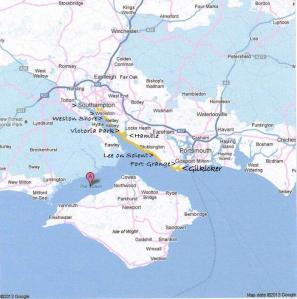
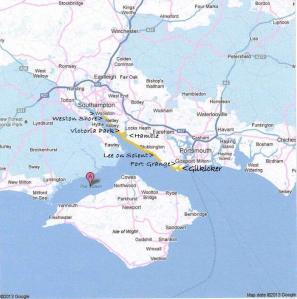
Solent map googleSouthampton

In the past, if  you’d taken the Floating Bridge over the River Itchen from Woolston then you would be close to Southampton Docks and as a child, when holidaying with my Grandma we used to do the round trip… over to Southampton via the Floating Bridge and back via Northam Bridge, or the other way around if that bus came first at the end of Newtown Road. A lady at my book launch at Woolston Library reminisced,

‘Wasn’t it irritating,’ she said, ‘that the bus always used to leave just as the Floating Bridge reached the shore!’ We all laughed sharing her memory.

Did you know that the Channel Island ferries used to leave from the docks at what we know as Ocean Village today, back in the nineteenth century?

To present old Southampton I am going to share with you another selection of Grandpa’s postcards, dated in the Edwardian era in the early years of the twentieth century. I can find no identical postcards on the internet and believe they do not hold any copyright due to their age.

Leaving the Floating Bridge we will first walk up Bridge Street where you can see the tram tracks:
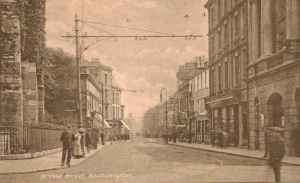
Bridge Street

Then we will head north to St Mary’s Road:
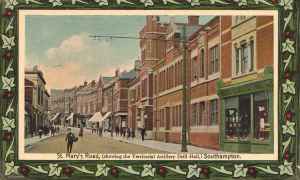
St Marys StreetFurther north of the city to Southampton Common and Lover’s Walk:
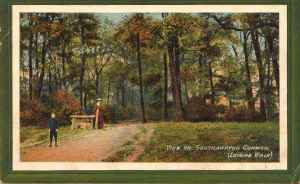
The Common Lover's WalkAlthough the walk to the common would be quite a long one in today’s terms, the people of those days thought nothing of such a walk on their half day off, to snatch moments with their loved ones and enjoy the fresh air. The Common saw famous air displays at that time too. If walking to the common was out of the question then Southampton also enjoyed Palmerstone Park close to the City centre:
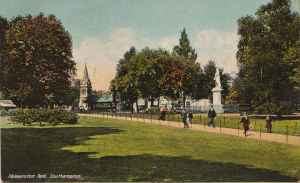
Palmerstone Park

Now we are back in the city, Tudor House museum has changed little and has recently been renovated. It is pleasant to have a stroll along the quieter back streets along the top of the wall:
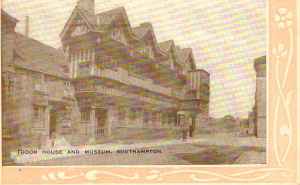
Tudor House

Out Grandfather had a shop near to the Bargate not far away, before they knocked part of the wall down for the tram route.
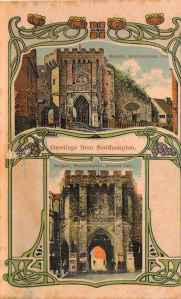
Bargate

Taking what my sister and i used to call the thirty nine steps when we were small you can walk down the wall. The shots below are still recogniseable although in front there is now a car-park and the West Quay Shopping Centre. This fascinating shot shows before and after the reclamation of the land to build the modern day docks, the first part of which was opened in 1842:
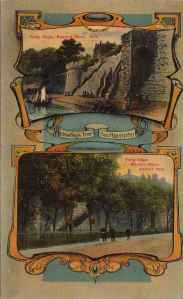
The wall

Following the wall along we are back down at the harbour and here is the South Western Hotel, recently converted into luxury flats and you can still see the structure of the docks railway station behind it although the busy streets in front take a while to cross, unlike the picture below:
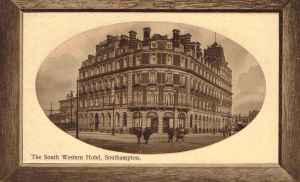
Western Hotel

And finally here is another ‘then and now’ postcard which shares so much of history with us in a snapshot, but of course the ‘now’ in this postcard is over 100 years ago!
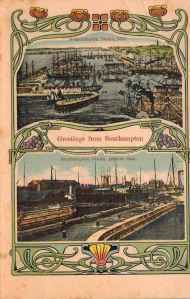
The docksAs one of the ladies on my last post of less common postcards of Old Woolston commented, these are a wonderful resource for research and ideas for writing. For me they are more than that. It’s just a pleasure to browse and wonder at the stories they tell and see places where my family lived and worked, but were also inspired enough to leave a trail behind.
Leave a comment

Filed under Family History, Research, Southampton, Virtual Tour of the Solent and Beyond, Woolston

The Solent Area Virtual Tour no 7 ~ Woolston and Itchen Village

Solent map googleWoolston

Today I am going to share with you a snapshot of old Wooston through copies of my Grandfather’s book of postcards. They are not dated, but looking at postcards of a similar era I would certainly say they were Edwardian.

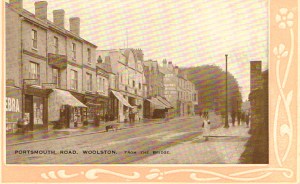
Portsmouth Road Woolston Southampton

Portsmouth Road Woolston Southampton

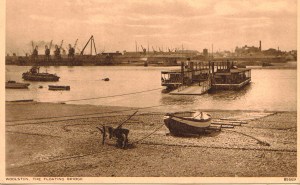
Above is the Portsmouth Road on its way down towards the Floating Bridge, and below is the Floating Bridge looking over towards Southampton:

The Floating Bridge Woolston

The Floating Bridge Woolston

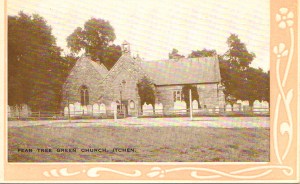
Then, travelling up the road to the outskirts of Itchen is Pear Tree Green church, not changed much today and still on the green overlooking the River Itchen:

Pear Tree Green Church

Pear Tree Green Church

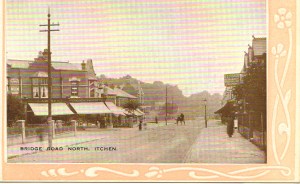
Still on the Itchen side of the Portsmouth Road is Bridge Road. The little of it left today is under the new bridge:

Bridge Road

Bridge Road

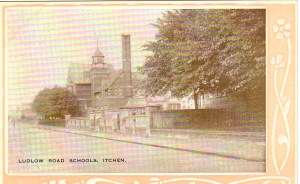
Many locals will remember or recognise Ludlow School, still on the Itchen side of the Portsmouth Road although many called it Woolston:

Ludlow School Itchen (Woolston)

Ludlow School Itchen (Woolston)

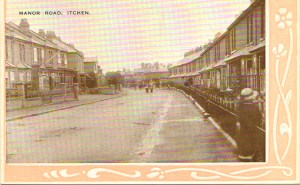
Here we have Manor Road. Many of these streets in and around Woolston look much the same today:

Manor Road.tif

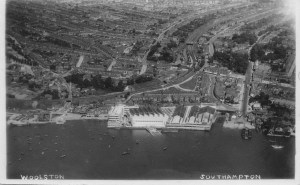
Now we move much later and here is an ariel photo of the Supermarine Works in Woolston which I date in the 1930’s. It was bombed and flattened in 1940.

Supermarine Woolston

Supermarine Woolston

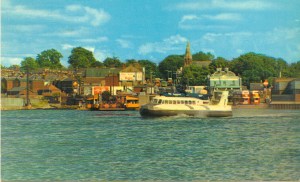
Finally one of my own postcards from the 1960’s of the hovercraft which ran from just over the river to the Isle of Wight:

Hovercraft to Isle of Wight

….and so what are Woolston and Itchen Village famous for, apart from being the location from which my second novel Ancasta Guide me Swiftly Home flows.

Firstly there’s Supermarine, initially famous for winning Great Britain the Schneider Trophy back in 1931. It was first opened and the name ‘Supermarine’ emblazoned on its roof 100 years ago in 1913. (even though the company was not registered officially under that name until 1916.) Famous in those days for its flying boats and then its sea planes, it must have been a wonderful site, watching them glide along towards Southampton Water and take off. Of course, most people know Supermarine for the Spitfire and it was here that RJ Mitchell developed the first prototype, which my father was lucky enough to see on its inaugural flight.

Even before Supermarine there was Thornycroft, whose land on the banks of the river has finally been made safe, flattened and is being redeveloped. Wikipedia says that the yard launched over 100 ships between 1876 and 1889 alone!

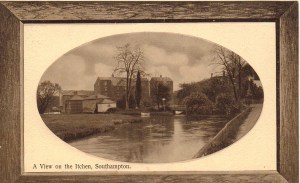
I am going to leave you with a lovely old photo of the River Itchen. Is this the mill at Swaythling just up the river in 1910 or in the late nineteenth century? I can find no photo which looks exactly like this but I’d love to know.

Mill Ichen river.tif

4 Comments

Filed under Ancasta, Schneider Trophy, Southampton, Supermarine, Virtual Tour of the Solent and Beyond, Woolston

Why Ancasta? ~ The Ancasta Stone

Ancasta ~ Guide me Swiftly Home

An unusual title, but as soon as I heard the name Ancasta, I thought she would be  a perfect follow on from my first novel ‘Riduna,‘ allegedly the Roman name for my favourite island of Alderney.

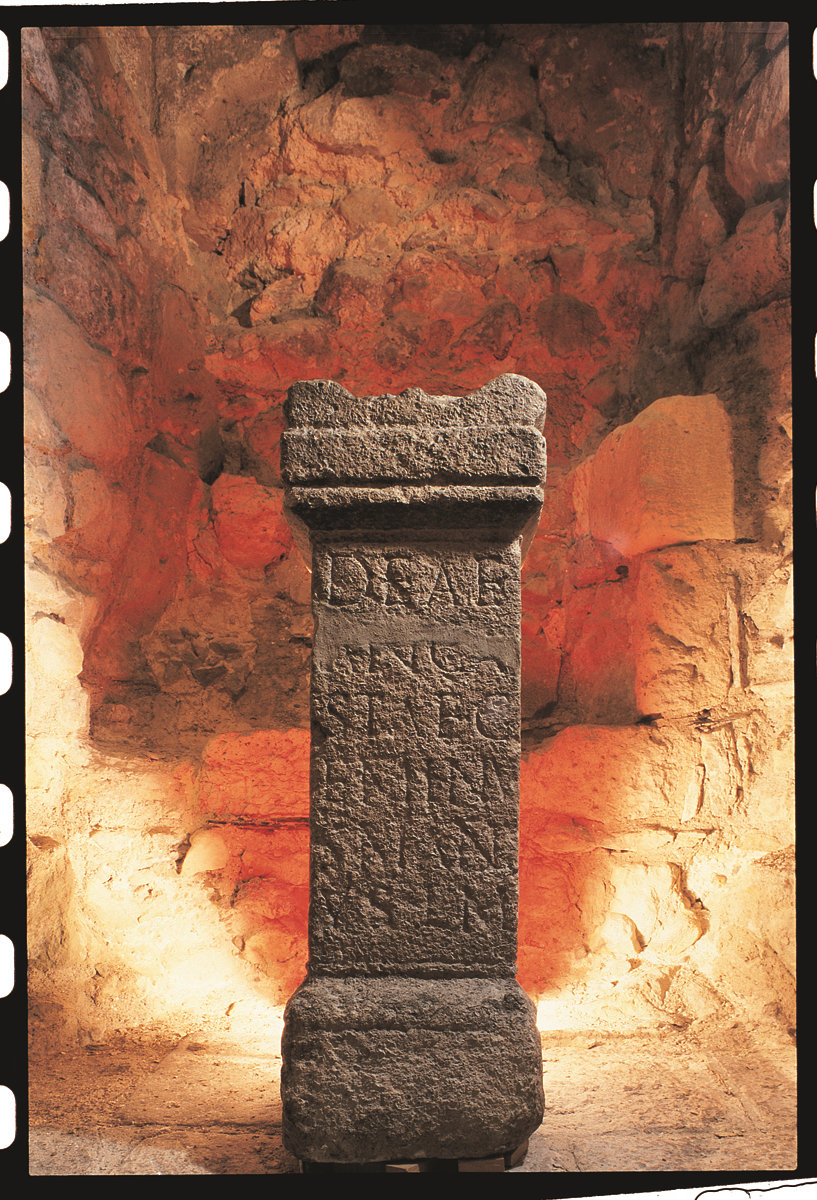
Ancasta is mentioned on an altar inscription from Clavsentvm, a Roman settlement, (possibly the first in the UK) found at Bitterne in Hampshire. It reads: (and I quote Mike Hart’s website here):

“DEAE ANCASTAE GEMINVS MANI VSLM (To the goddess Ancasta, Geminus Mani[lius] willingly and deservedly fulfils his vow), which represents the only known dedication to this goddess.”

In Southampton Sea City Museum

Mike goes on to explain the speculation regarding Ancasta, and it was this speculation which inspired me to name my second novel after her:

“Ancasta is known because of the inscription above and as such was probably a local deity. However, by comparison with the re-construction of proto-Celtic the goddess’ name can be broken down into the components *an-kast-a- (very swift one). It may be that she was a river goddess, asssociated with the nearby River Itchen (which would certainly fit with the interpretation of her name though this is merely speculative).”

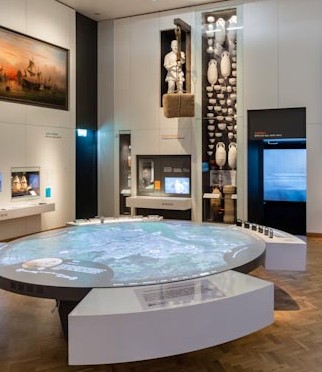
It was with excitement that I visited Southampton’s Sea City Museum for the first time this summer. It was not open while I was researching for the novel and here is a photo of the alter stone in its display case, in the ‘Gateway to Southampton Gallery.’

The Gateway Gallery is a fascinating reflection of all the many peoples who have arrived in the port of Southampton over the centuries. With the influx of each new arrivals, whether as an aggressive invader or to avoid deprivation or poverty, or just in search of a new and more fulfilling life, Southampton has changed and adapted.

To Harriet and Joe in my first novel ‘Riduna,’ Southampton represented a promise of work and a new life for their family. It would be a marked contrast to their lives in the Channel Islands on Guernsey (Sarnia) and on Alderney (Riduna) but they would have to adapt to survive, and adapt they did!

This gallery is only a small but interesting part of the whole museum, whose main focus is to tell the story of the Titanic, in a colourful, interactive manner, stimulating all of the senses. I even stood at the Titanic’s helm and attempted to steer her through the narrow permissible shipping lane. This was not only an enjoyable challenge but brought to my mind the realism on the first chapter of ‘Ancasta,’ when Edward, the captain of the LSWR Princess Ena steers his ship  along this course.

This exhibition is excellent, not only to explore the controversial sinking of this infamous ship, but also in giving a greater awareness of the impact of the port on the life of Southampton, from dealing with copious laundry, the infrastructure needed to ensure fresh provisions were available and the connecting services and transport facilities were at hand. Of course, this is as true today as it was back in 1912 when the Titanic left Southampton.

Ancasta ~ Guide me Swiftly Home‘ tells a story of an ordinary family living at that time in Woolston, Southampton. Harriet, in setting up her guest house on the banks of the River Itchen, becomes part of that infrastructure, and as her sons begin to work at Supermarine, it is to the skies they look up to, as much as across the river and along Southampton Water. Many a time they prayed for the swift and safe return of both family and friends and Ancasta tells the story of those who left and those who remained at home waiting for news.

I would like to thank the Arts and Heritage Office from Southampton City Council for kindly allowing me to use the photos. (Please note that taking photographs is not permissible in the museum)

5 Comments

Filed under Ancasta, Riduna, Southampton, Supermarine, Woolston