A memorable spine – tingling moment at today’s Read Aloud event was when Wifred Owen’s poem ‘Anthem for Doomed Youth’ was being read:
“What passing-bells for these who die as cattle” on cue the town hall clock began to chime
“………No mockeries now for them; no prayers or bells ” the chimes struck twelve solemn notes as the remainder of the verse was read
Nor any voice of mourning save the choirs, –
The shrill, demented choirs of wailing shells;
And bugles calling for them from sad shires.”
![DSCN1206[1]](https://dianajacksonauthor.com/wp-content/uploads/2014/06/dscn12061.jpg?w=300&h=225) There was a select gathering at this informal event at Luton Library as letters, poems, newspaper articles, posters and extracts of prose were read out depicting scenes from ‘call up’ to Armistice.
There was a select gathering at this informal event at Luton Library as letters, poems, newspaper articles, posters and extracts of prose were read out depicting scenes from ‘call up’ to Armistice.
The pressure on the young men to volunteer and the women to persuade them ~ the initial sense of adventure ~ followed closely by the destructive nature of war and violation of human dignity ~ the celebrations of the end of the Great War and the surprising local Luton stories of the aftermath – all put together very sensitively by the library staff.
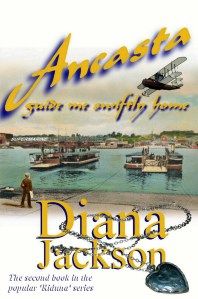
I could have chosen many extracts from ‘Ancasta ~ Guide me Swiftly Home’
~ Victor, one of the few who returned injured to his island home of Riduna and sought solace and sustenance for his family by fishing, only to hear the sounds of gunfire over the water ~or ~
~ The sea plane carrier Ben my Chree and its eventful contribution in Turkey, before it was sunk in the Med.
Instead I chose the unusual moment Harriet realised war was finally over ~ particularly pertinent for any visually impaired ‘witnesses’ of the event.
Extract from Ancasta Guide me Swiftly Home by Diana Jackson
“It was November 11th and Harriet had walked down to the grocers. The foggy morning seeped through the community with a sense of subdued anxiety. She passed by neighbours who barely acknowledged recognition as they nodded and swiftly went their way. Harriet didn’t know what was drawing her to the river’s edge but once she was there she could see little through the swirling fog. There seemed to be none of the usual movement of water traffic and she sensed calmness as she stood and listened to the water lapping at the water’s edge.
In the far distance a single deep noted siren sounded, almost certainly from the direction of Southampton Docks. Another higher noted echo gave its light-hearted reply and then it was as if all the dormant vessels wished to muscle in on the conversation, as a cacophony of sound drifted up and down the river, ever gaining in enthusiasm and intensity. Harriet smiled. There could be no doubt about their message to everyone. The war was finally over.
Behind her Harriet could hear the people flock out of shops, factories and houses on to the main streets of Woolston. For a moment she stood still soaking up the atmosphere in a sense of disbelief. Armistice had been declared and Harriet looked on as her neighbours drew untapped energy from deep down to dance and sing. Then she made her way through the crowds; the carts and trucks brought to a standstill, stopped by the powerful surge of the celebrations.
Harriet reached Bourton Villas just as her two patients hobbled out of the front door to see what was happening. At that moment Ernest appeared and unlike his usual reserved self he took his mother’s hand and spun her until she began to laugh in protest for him to stop. Timothy and Sarah came rushing over to her next and she gave both of them a hug as Ernest claimed Sarah for a dance. Looking up, she saw Tom standing alone in the doorway. When he saw her looking at him he retreated back inside Bourton Villas and as she followed him she found him sitting quietly on their garden bench appearing oblivious to the celebrations. She sat down next to him, her hands falling into her lap as they sat there in their own silence.
In that moment she became aware of her shabby coat, over-mended dress and worn out shoes. Her eyes were also drawn to her thin spindly fingers and she smoothed the coat over her bony knees; all exuberance drained from her as she was struck by the legacy of the war both in tragedy and hardship. How could they heal from such life and memories? Tom too was thinking of the suffering, but his thoughts were of his brother and many friends who had lost their lives over in France. On cue, their little robin made a well timed appearance, hopping on to the hard ground to peck at some crumbs Tom had just thrown out.
At that point the whole family streamed into the yard, shattering their haven of peace and the robin disappeared into the bushes. Ernest called everyone back into the kitchen where he poured their last drop of brandy into glasses and as a family they toasted the end of the war. After that they each drifted back to work, leaving Harriet quietly mulling over the implications of the day’s events as she prepared the still meagre evening meal. The declaration of peace was certainly a wonderful start, she reasoned, but it would take so much more to return to any form of normality. Her spirits had certainly lifted, although it was far too soon for her to try to imagine better times ahead. She would continue to take a day at a time.”
More information about Luton in World War One can be found on the Wardown Museum site and if you have stories to share which have been passed down through the generations of your family, then there is an email for you to get in touch.
 Diana Jackson