Category Archives: The Great War

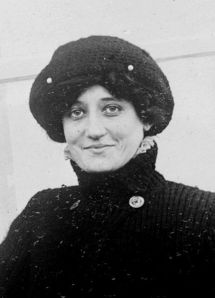
Raymonde de Laroche ~25th November 1913

431px-Raymonde_de_LaRoche_HeadTo add to my recent posts about early female aviators I must mention this French lady:

Raymonde de Laroche 1886 -1919

Background and Inspiration to Fly

Raymonde always enjoyed sport and motorcycles but was inspired to learn to fly after watching Wilber Wright’s flight demonstrations in Paris in 1908. In 1909, under the instruction of Charles Voisin a personal friend, she took off for the first time. I like the story that she disobeyed his orders not to take off on that first occasion. Whatever the truth she was certainly a headstrong and determined young lady.

Her achievements

She gained her pilot’s licence in March 1910 and as many aviators of her time took part in meets and shows. Although injured in September 1912 at the Reims Air Show and a subsequent car crash, she recovered fully and won the Femina Cup after a four hour, non stop long distance flight on 25th November 1913.

In WW1 she served as a chauffeur and engineer, confidently driving officers too and from the front.

Notable Difference

Although of humble birth, the daughter of a plumber, she called herself Baroness, but after the war in 1919 she hoped to become the first female test pilot in Le Crotoy. Unfortunately the plane she was in crash landed and she was killed.

If you are interested in early female aviators I have done a series for this blog but here are some other links:

Mother Nature Network – 8 Famous Female Aviators

Women of Aviation Worldwide Week in March

NB I was interested to see Harry Harper, the Aviation reporter of the Daily Mail at that time, writing about Raymone. I was so intrigued by Harry’s name appearing so many times whilst I was researching for my novel Ancasta Guide me Swiftly Home that he became a character in my novel and he is a man I intend to research in the future.


2 Comments

Filed under Early Flight, Frivolous Flying Facts, Research, Role of Women, The Great War, WW1

100 years ago this October Supermarine was born

What does the name ‘Supermarine’ mean to you? The Spitfire? Nothing? An important company in Southampton’s history and later Swindon too? If you’re a football supporter to Swindon do you know what the connection is?

It meant little to me until my parents started looking into our family history and Dad began to speak of how important Supermarine was in our family when they lived in Woolston and once my interest is stirred I have a need to go and do some research. Why?

  • to know why the company was important historically
  • to find out what impact it had on my family
  • to understand how it changed every day lives of my family, their friends and neighbours.

This satisfies the social historian in me….not an exact science of facts and figures but and exploration of real lives for real and imaginary people. So here’s the historical facts laced with my interpretation in italics:

In 1913 Pemberton Billing, often described as a maverick in political terms, approached a little known boat builders called White’s in Itchen Village on the banks of the River Itchen.

I can imagine the rumours in the village pub, The Yacht Tavern while negotiations too place with Hubert Scott Paine in his yacht moored up the river.

He wanted to use the skilled craftsmen to build flying boats and an agreement was made to begin production in October 1913.  Supermarine was not the official company name until 1916, but Billing registered the name for telegram purposes but also had the name emblazoned on the roof in November 1913. 

I believe that the people of Itchen Ferry and Woolston would have been proud of the new developments and excited to see the newly developed flying boats take off from the river near where they lived and worked.
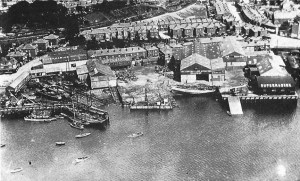
Supermarine Works & CHANNEL on slipway

Why Supermarine? The main use of flying boats for the military at that time was to look out for submarines….sub..under the water…supermarine…over the water. 

Why did he have the name painted on the roof? To be noticed from the air of course, especially to catch the attention of the military to be taken seriously and to gain orders and build business.

(For the family in my novel ‘Ancasta Guide me Swiftly Home’ living in Woolston, split from Itchen Ferry only by the Portsmouth Road, I reasoned that this could only be good news, since two of the characters in my novel Ernest and Jack already worked at White’s. It meant better job security and job prospects.)

Flying boats were important in WWI to protect convoys, search for submarines and also to bomb strategic sites, out in Turkey for example.  In WWI they also helped in rescue missions for crews of sinking ships. It was a innovative development for the navy with the newly opened RNAS station along Southampton Water at Calshot. With the first sea plane carriers also in operation during WWI technological development was moving fast.

Why were flying boats so important to us in Britain?

Firstly there was no infrastructure of runways before WWI. Planes just landed where they could on fields and park land so it was quite reassuring, us being an island, that the aircraft could land on water. This was important, not only to impress the military but commercial projects later on. In 1913 it was only 4 years since the first ever flight across the channel.

If entrepreneurs were to persuade the wealthy public to pay for air transport, it was thought that they would be happier that the craft could land safely on land or water.
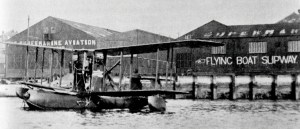
Supermarine Works c1919

Supermarine Works 1919

Supermarine’s most famous engineer RJ Mitchel was responsible for the development of more famous sea planes; the Sea Lion which won The Schneider Trophy in 1922 and the S6B  which won the Schneider Trophy outright in 1931.

Mitchel’s developmental work to such a high specification led on to the timely Spitfire. In the gallery of Solent Sky, the aviation museum in Southampton , there is an exhibit of small model aircraft right from those early sea planes to the Spitfire.

Many say that, if it hadn’t been for the development of the S6B, an amazing feat of engineering by Mitchel to develop the fastest amphibian aircraft in the world at that time, the technology would not have been in place to develop the Spitfire.

And so Supermarine was born one hundred years ago. It was a major employer in the area up until the second world war when Woolston’s Supermarine Works were bombed out, after the local people had been inspired by witnessing the first ever flights of the Spitfire right over their heads, including my father.

To me the facts are important, but it is the way in which I can weave lives of ordinary people through these facts that brings history to life. 
Leave a comment

Filed under Ancasta, Early Flight, Flying Boats and Sea Planes, Research, Schneider Trophy, Southampton, Supermarine, The Great War, Woolston

Reviewing my rewarding but rollercoaster year of events ~ Advice to Authors

First of all I’d like to say thank you to everyone who has supported me this year, both the familiar and new faces. I really appreciate it and I’ve gained so much pleasure from meeting and talking to so many people.

I’ve been out ‘on the road’ frequently since March this year and as a relatively unknown author I have to admit that my emotions have gone sky high with the successes but plummeted with the occasional less than successful events and it made me think.

Is it worth the energy, time and of course money spent in organising events?

Are there any hidden benefits?

Here are my thoughts:

1. Attendance at author talks ~I have had audiences from 5 up to 80 but usually somewhere in between. The high turn-out does tend to be with organisations which have regular meetings and you are on their ‘guest speaker’ list. The buzz from a large audience is electric and if you enjoy reaching out to people in this way, my advice would be to advertise it on your website, (which I haven’t yet) and try to get on lists, probably at the local library (if you’re lucky enough to still have one!) There’s a joy in being asked rather than touting for business too. It means that your name has been referred by another group or reader. Great news!

At one venue the organiser quoted another author,

‘I won’t agree to come unless there’s an audience of at least 100.’

What do you think of such a reaction?

Hidden benefits ~

  • Publicity, posters which reach a far wider audience
  • word of mouth
  • positive contacts with the organisers increasing your credibility and reach as an author
  • building your ‘platform’

 Downside ~ planning a talk takes time, travelling costs (ask if you are entitled to travel costs on top of your fee before the event)

2. Book-signings at Bookshops ~ Always a pleasure to me. (apart from one occasion when the timing and inclement weather led to a disappointing turn out) You are more likely have a favourable response if you are local, the content is set in the locality of the bookstore, you have been on the local radio or in the newspaper.

 If you have a book launch in a book shop then the store will benefit from visits from family, neighbours, colleagues and friends but if not, what is the good of only selling maybe ten to twenty books?

You are meeting new readers, engaging with them in conversation which does not always lead to a sale but is rewarding nevertheless.

 Hidden benefits:

  • As above publicity, posters but you are also making links with the people who matter.
  • If you sell well then the manager is likely to think favourably about selling your novels in future….which is harder than ever for an independent. Waterstones, for example, used to sell books from local authors and often had a section for them. Policies have changed and the decision of approval for stocking books happens through a central buyer.
  • Thus you are generating goodwill through your efforts and that must be good!
  • Reaching out to a totally fresh audience.


Downside ~ travel costs and time taken, especially when travelling distances and you must balance this with the need for Amazon reviews and this is a balancing act I’m not very good at.

  3.      Marketing Outside the Box (click on link for previous post)

Fetes, shows, stalls ~ all of these options are lots of fun and you may find, like myself, that you are reaching out more specifically to your target audience that way. For example I hope to have a stall at The Wrest Park, World War One event next year. It ticks lots of boxes for me:

  • It’s local
  • My novel ‘Ancasta Guide me Swiftly Home’ tells a quite different story of WW1
  • My murder mystery, out soon, mentions Wrest Park and is set in the locality, partly at the end of WW1 and for the most part in the future

Hidden Benefits: Other benefits could be

  • At a village fete you might reach more of your neighbours than before and maybe give a donation to a local charity or church too
  • At an arts and craft fair your book may just be that Christmas gift that someone was looking for, signed to an individual by the author no less!
  • You can hand out publicity or mention future projects too


I’m sure you can add many more ideas and benefits. You certainly need to handle your expectations carefully, but maybe, with a lot of time, good will and effort, one day you will have that queue waiting outside the store before you begin. Well, you can dream! There’s no harm in that, is there?

Let me know what you think and any ideas you have.

1 Comment

Filed under Book Shops, Events, Marketing your novel, Talks, The Great War, WW1