Category Archives: Research

Virtual Tour of the Solent and Beyond~No 13~Over the English Channel to France in the Great War

Over to France

Over to France

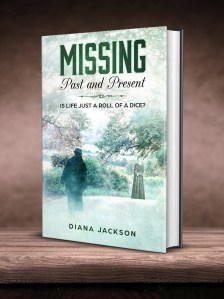
Ancasta Guide me Swiftly Home is set between 1910 and 1920 and so the members of the Newton family see many facets of World War One; the life changing experiences of the women at home in Woolston as Harriet opens her home for convalescent soldiers; the marked effect on their children and Jane’s world at The Royal Victoria Hospital. Life goes on as best it can.

There is a continuous flow of ships up and down Southampton Water, including Edward’s ship, commandeered to send new troops to France and to return full to the gunnels with the injured. Every home in every street is affected, when memories of the horror of the Titanic have barely had the chance to heal. Although Ancasta dwells more on those who remain in Woolston, France is never far from their minds, especially when Anthony, Harriet’s son-in-law is trained initially as an observer, on reconniassnace missions taking photographs of the area of conflict from the air. Then, having taken part in several successful fact finding missions he came home to fulifil his wish to complete his full pilot training.  

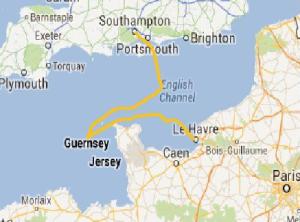
Thus Ancasta has chapters which tell Anthony’s story from his training at Gosport to his long journey to France, by ship to Le Havre and then by barge up the river to Rouen; the sights on this trip in sharp contrast to the ones he will witness shortly. We read of some of his  experiences in France through letters to his wife wife Sarah, who has moved back home to Woolston to live with her mother Harriet for the duration of the war. Through these extracts we learn of Anthony’s joy of learning to fly and we see the war on the home front through his eyes, not in the depths of the muddy fields of France but almost as a movie from above. It is nonetheless vivid in its devastation.

These chapters were inspired expecially by an old tome I borrowed from The Shuttleworth Archives called ‘Sagittarius Rising’ by Cecil Lewis, a gripping true account which reads more like a novel in itself.

Will Anthony be one of the lucky ones to return? What are the odds with my no 13 post on my virtual tour?

When you think of the sacrifice so many of these young men made for us all though, luck doesn’t really come into it, does it?

The name of the novel ‘Ancasta’ is even more pertinent during this period as the women prayed for the swift and safe return of their loved ones from France just as the Romans prayed to Ancasta, ‘The Swift One’ centuries before in this very location.

There are many websites and blogs related to The Great War but here is a link to one I follow:
Great War Photos

Leave a comment

Filed under Ancasta, Early Flight, Research, Role of Women, The Great War, Virtual Tour of the Solent and Beyond, Woolston, WW1

The Solent Area ~ Virtual Tour no 8 ~ Southampton

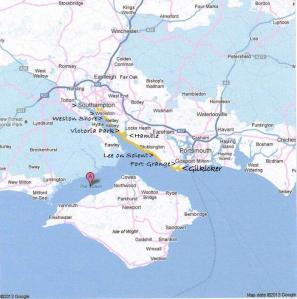
Solent map googleSouthampton

In the past, if  you’d taken the Floating Bridge over the River Itchen from Woolston then you would be close to Southampton Docks and as a child, when holidaying with my Grandma we used to do the round trip… over to Southampton via the Floating Bridge and back via Northam Bridge, or the other way around if that bus came first at the end of Newtown Road. A lady at my book launch at Woolston Library reminisced,

‘Wasn’t it irritating,’ she said, ‘that the bus always used to leave just as the Floating Bridge reached the shore!’ We all laughed sharing her memory.

Did you know that the Channel Island ferries used to leave from the docks at what we know as Ocean Village today, back in the nineteenth century?

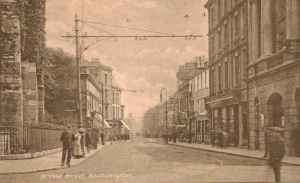
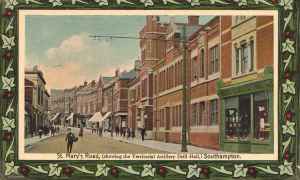
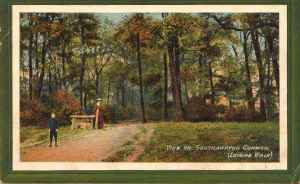
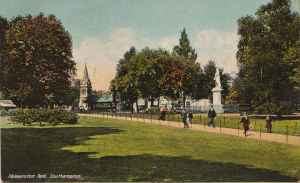
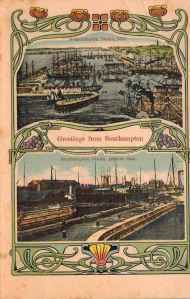
To present old Southampton I am going to share with you another selection of Grandpa’s postcards, dated in the Edwardian era in the early years of the twentieth century. I can find no identical postcards on the internet and believe they do not hold any copyright due to their age.

Leaving the Floating Bridge we will first walk up Bridge Street where you can see the tram tracks:

Bridge Street

Then we will head north to St Mary’s Road:

St Marys StreetFurther north of the city to Southampton Common and Lover’s Walk:

The Common Lover's WalkAlthough the walk to the common would be quite a long one in today’s terms, the people of those days thought nothing of such a walk on their half day off, to snatch moments with their loved ones and enjoy the fresh air. The Common saw famous air displays at that time too. If walking to the common was out of the question then Southampton also enjoyed Palmerstone Park close to the City centre:

Palmerstone Park

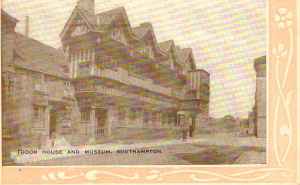
Now we are back in the city, Tudor House museum has changed little and has recently been renovated. It is pleasant to have a stroll along the quieter back streets along the top of the wall:

Tudor House

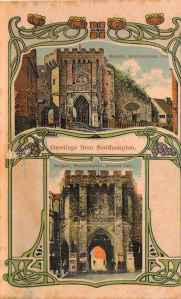
Out Grandfather had a shop near to the Bargate not far away, before they knocked part of the wall down for the tram route.

Bargate

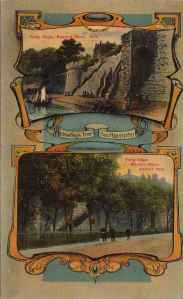
Taking what my sister and i used to call the thirty nine steps when we were small you can walk down the wall. The shots below are still recogniseable although in front there is now a car-park and the West Quay Shopping Centre. This fascinating shot shows before and after the reclamation of the land to build the modern day docks, the first part of which was opened in 1842:

The wall

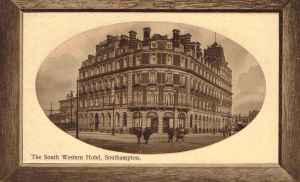
Following the wall along we are back down at the harbour and here is the South Western Hotel, recently converted into luxury flats and you can still see the structure of the docks railway station behind it although the busy streets in front take a while to cross, unlike the picture below:

Western Hotel

And finally here is another ‘then and now’ postcard which shares so much of history with us in a snapshot, but of course the ‘now’ in this postcard is over 100 years ago!

The docksAs one of the ladies on my last post of less common postcards of Old Woolston commented, these are a wonderful resource for research and ideas for writing. For me they are more than that. It’s just a pleasure to browse and wonder at the stories they tell and see places where my family lived and worked, but were also inspired enough to leave a trail behind.

Leave a comment

Filed under Family History, Research, Southampton, Virtual Tour of the Solent and Beyond, Woolston

Murder Mystery Evening ~ What a Hoot!

Apologies for a break in my Virtual Tour of the Solent Area and Beyond but this is one of my spontaneous off the peg posts!

It was the first weekend since Christmas that both of us felt well enough to entertain and so, needing some laughter, we invited some close friends to Waybak for a Murder Mystery evening. Taking my role as a maid in the plot, I was awake early on Saturday morning cleaning, setting the table and preparing the meal. You see, each part of the ‘game’ is played between three courses.

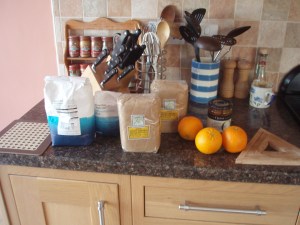
I sent my hubby off to the shops with a short shopping  list. Not used to shopping for such things I had a phone call from him in the baking aisle. (don’t you hate it when people do that when you’re in a supermarket?)

OLYMPUS DIGITAL CAMERA

‘How much do you mean by a small back of flour and brown sugar?’ he asked.

‘Oh, I need 150 grammes of each,’ I replied.

Half an hour later I couldn’t hide my mirth when he arrived home with one and a half kilogrammes of each. Is this a hint that I should be baking more often!

The instruction booklet gives you ideas for a suitable menu but I adapted it to

Leek and Potato Soup

(which I made on Thursday, ready to warm up)

Lamb Stew

(I made it more of a hot pot with potatoes sliced on top, cooked very slowly in the oven)

Ginger and Orange Steamed Pudding

(One of those you turn out on a plate and it’s grandly covered with syrupy slices of orange)

or

Lemon Meringue Pie

(The only part of the meal I bought)

As I busied myself in the kitchen doing tasks like covering the pudding basin with greaseproof paper, tying it with string to give it a handle and topping the pot up with water from time to time I was really getting into my part. I hadn’t made a steamed pudding on the stove in years.

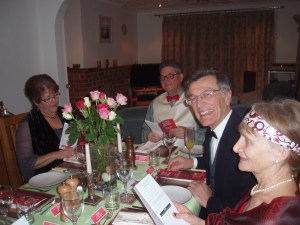
Set in 1924 each person invited had been asked to dress as their character in an Agatha Christie murder. As they arrived I showed them into the parlour for us to introduce ourselves and the fun began. With two Americans (a rich tycoon and a poor step daughter) two French (a count and his current mistress) and two English (myself the maid and the Rt Honourable Lord Carrington) husband of the murdered lady) we took on our roles with enthusiasm and my quiet acquiescent manner as a maid was absolutely perfect for serving the courses between sessions of acting, long discussions and questioning.

OLYMPUS DIGITAL CAMERA

It was to our amazement that it was approaching 10 pm, after we had all made our accusations, that we sat down to watch the video giving us the solution. I cannot tell you who the murderer was because, in true Agatha Christie style, that would give the game away but I can tell you that one of us was!

My mind also strayed occasionally to Norman Campbell, the man whose memoirs I have now completed, who would have been fifteen in 1924, just at the time his childhood sweetheart May went into service in a large house in Wimbledon. I felt such an affinity to May! 

As an author, who is in the middle of writing my first murder mystery, it was also interesting to see how the decisions of each character was swayed by new nougats of evidence, as a reader might be. Too much information and the game would be given away too early. It was also fascinating to see how the ‘red herrings,’  the facts to mislead us, played out in the minds of each person present differently. Set in 1924, it was also perfect because it was the period I am researching for the third book in The Riduna Series.

A truly enjoyable evening was had by all and so much laughter has not been heard at Waybak for an age!

label

7 Comments

Filed under Research