Category Archives: Research

Amazing Female Aviators in the Early 20th Century ~ Harriet Quimby 1875-1912

Whilst researching for ‘Ancasta Guide me Swiftly Home’ I read a great deal about early aviators and was exciteded to read about Harriet Quimby, even though it had nothing to do with my novel. Anyone writing a novel knows how easy it is to get sidetracked and it led to me finding out about other female pioneers in aviation. After all, everyone has heard of Amy Johnson and Amelia Earhart from the 1930’s, but I was surprised to discover many women whose endeavours matched those male counterparts of their era as far back as 1910! Their daring to venture in what was seen as a man’s world accomplished much more than their achievements in flying alone, although these were certainly remarkable. They also designed clothes, opened factories, begun flying schools and fought prejudice at many levels. They were not, as I had imagined, all rich young ladies with plenty of time on their hands, but women who dared to be different.

I’d like to share this in posts over the next couple of weeks. If you enjoy my posts then please let your friends know and share it on twitter and facebook.

Harriet Quimby 1875 – 1912 ‘The Green Eyed Beauty’

Background and inspiration to fly ~ Harriet Quimby came from a poor American family, but by working herself up from journalism and theatrical writing she became a competent and successful screenwriter for the silent movies of her time. It was after attending the Belmont Park Air Tournament on Long Island that she decided she must learn to fly.

Aviation achievements ~ In 1911 she gained her pilots licence and became the first female American to gain an Aero Club of America Certificate. As many pilots of her day, Harriet gained experience and a way to fund her ambitions by participating in several air shows, but her main achievement was in April 1912 to be the first woman pilot to fly across the English Channel.

Death ~ Unfortunately she met her early death as a passenger in a two-seater Bleriot, only three months later in July 1912.

Notable difference ~ Harriet was also noted for her beauty and her dignified manner, but her other notable legacy was that she designed a suitable style of dress for women pilots of her day. She was known for her purple satin one piece flight suit which converted into pants (trousers) when flying but to a skirt when out of the aeroplane so that she did not offend the dress expectations of her era.

Harriet Quimby certainly moved the women’s movement forward in her own way and her fashion sense would amuse and please a friend of mine I visited recently who still keeps up to date with what is fashionable.
Leave a comment

Filed under Early Flight, Frivolous Flying Facts, Research, Role of Women

Virtual Tour of the Solent and Beyond ~No 14~WW1 in the Med and Port Said

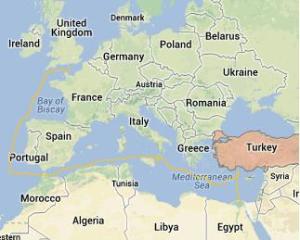
If this is the first of my virtual tour posts that you’ve stumbles upon, since Christmas I’ve been on a journey around the Solent from Fort Gilkicker, along Southampton Water, back out to Calshot, over to The Channel Islands and France and today we travel in our mind’s eye to Turkey and the Mediterranean. This is the journey of Ancasta Guide me Swiftly Home, my second novel, and the destination of Harriet’s most adventurous son as he played his part in WW1.

It is the stories of Jack and his brother Tom which makes Ancasta such a unique story of WW1, but without giving too much away in today’s post I will explain the background to Jack’s tale. Jack was the lively son, full of a sense of humour and a need for adventure. (Tom was the quite, thoughtful one and Ernest the serious young man who took role as head of the family since his father died in earnest!) Mechanically minded Jack was never more at home than when he was working on engines. Apprenticed at White’s Boatyard as an engineer on the banks of the River Itchen, it was the most natural progression in the world for him to transfer to Calshot, where he maintained flying boats at the new RNAS station in 1913.

As war broke out he joined up and his story, told by letters back home to his loving wife Hannah, were of his excitement, joys and frustrations of working on one of the earliest sea plane carriers in WW1, The Ben my Chree, meaning ‘Lady of my Heart,’  which I thought such an apt double entendre. Was it his wife or his ship and the sea planes he so lovingly worked on who stole his heart? You, the reader, must decide.

Turkey was where the Ben my Chree contributed most to the war effort and this is where my novel describes real events through theSolent Google Maps Turkey Port Said eyes of Jack. My research, carried out mainly at the Shuttleworth Archives, of the Ben my Chree led me to visit The Fleet Air Arm Museum at RNAS  Yeovilton, where I was excited to see scale models of early sea plane carriers like the one Jack served on. (In fact, I was more enthusiastic than my husband, who was keen to see jets and planes of a more modern era which meant nothing to me!) Before doing this research I was unaware of the part sea plane carriers played in WW1 and I hope that my novel will prove to be informative as well as a good read.

On a couple of occasions Jack’s ship docked in Port Said for repairs and supplies. I had vivid pictures of the port in my mind from early postcards my grandfather had collected of the area when he was in the Navy. I cannot share them with you today but hope to in the future.  Since reading Ancasta my father has told me a story of my family history of which I was totally unaware before writing the novel. I am bursting to tell you this but can’t, and if you’ve been following my journey into writing from the beginning it is certainly not the first strange coincidence to take place. What I can say is that my grandfather actually met his brother quite by chance in Post Said back in WW1, but I’m afraid I’ll just have to let you read the book before I tell you what really happened.

Back to my novel Ancasta Guide me Swiftly Home, what Hannah makes of these adventures as she is left at home with their young daughter waiting for news is the other side to my story of course. How did Jack and the pilot of his planes contribute to the war effort? Did the Ben my Chree survive the war? Did Jack return home?

All these questions I cannot answer. You’ll just have to wait and see, but if you’ve read Ancasta and want to know the true coincidence then drop me an email and I’d be happy to tell you!

diana@dianamaryjackson.co.uk

Leave a comment

Filed under Ancasta, Early Flight, Family History, Flying Boats and Sea Planes, Research, Virtual Tour of the Solent and Beyond, WW1

Being Compared to a Best Seller ~ A Double Edged Sword

In the last few months I’ve joined The Sarnia literacy Society on Facebook and have enjoyed talking about such books as Ebenezer le Page, a delightful story written like memoirs of an elderly gentleman and his life on Guernsey. Apart from getting lost occasionally in a plethora of friends and relations, I found the book truly delightful and an insight into what life on Guernsey was really like in the last century. I laughed and cried and I oood and ahhed alongside old ELP and I certainly missed him when I’d finally finished the book.

In the last couple of days, though, I had an ‘ouch’ moment when I turned to the site and read the comments on ‘The Guernsey Lteracy and Potato Pie Society.’ Wow! Isn’t this book still stirring emotions and on this Facebook page I read only negative opinions. The contrast between these and the gushing comments to dear old E le P were stark and I respect every point I read.

What are my feelings about the book though? I agree that it was badly researched; the people were not true Guernsey; names were incorrectly spelt and places unrecognisable. In fact, they were rarely described in detail, not surprisingly since the author had barely visited the island but did her research remotely.

To her defence here, she was obviously so moved by the island that she began her research. Sometimes it happens like that to an author. An idea takes you and you just have to write.

On the other hand the novel has sold millions worldwide. Why? It was witty and gritty; it used well-known facts about life on Guernsey during World War Two and embellished them into a storyline which was easy to read and many of the characters warm and likeable; it was a great holiday read; there’s still a lot of interest in reading about the war…..I could go on. Or was it just luck, an incredible marketing campaign or the amusing, memorable title that did it? We shall never know.

And now here’s the rub! The Historical Novel Society when reviewing my first novel Riduna compared it favourably to this very book saying that anyone who enjoyed The GLPPS would love Riduna too! I was proud of being compared to this best seller. I decided to put the quote on the blurb for ‘Riduna’ when I asked for the rights back from the original publisher and relaunched Riduna last year alongside my second novel Ancasta Guide me Swiftly Home. It seemed like a good idea at the time.

Here’s where I am going to hold my hand up and be honest and constructive in my comparisons.

Firstly I wasn’t born on either island but my reasons for writing both novels did initially stem from my interest in my family history. My great-grandmother was born and lived on Alderney until the age of 15 when she was shipped to Guernsey. She later married my great- grandfather a Guernseyman. The more I researched about life on the islands in Victorian times, the more the shape of a novel unfolded before me. I found that my love of the islands as a child, rekindled on visiting several times as an adult, enhanced the more I read into the history. It was tantalising though in the details of social history left out of the history books and guide books and so I too was guilty of fabricating what I did not know. The characters seemed to live, work and develop though, in my head. I felt I had little control over them. I made mistakes too! A couple I felt very embarrassed about and wondered how I’d missed them once the novel was in print.

Researching for Ancasta has been very different. Instead of pouring over books and filling in the gaps with my imagination, I did that too, but I also approached experts who were so enthusiastic about their individual subjects that they checked relevant chapters for me and gave me valuable feedback. The reaching out to people, both on the islands and here on the mainland was a wonderful experience I will treasure and learn from.

Thus, when I relaunched Riduna I was able to make amends, reread it with new insight and polish it up a bit…after all, even with the help of the editorial services of my initial publisher it was still my first novel.

So, if you are an islander and happen to read Riduna or Ancasta, or a reader from anywhere in the world, I really don’t mind you being critical, as long as you do it kindly:-)

Any feedback gratefully received

diana@dianamaryjackson.co.uk

2 Comments

Filed under Ancasta, Book reviews, Research, Riduna, Writing a novel