Category Archives: Channel Islands

Migration and Immigration ~ Nothing New

Researching migration between the Channel Islands and the United Kingdom and beyond, gave me a wider perspective on issues regarding immigration in general. As the prosperity of each of the islands has ebbed and flowed, islanders have sought work elsewhere or mainlanders have moved to Guernsey and Alderney in search of work or a better life style. (Of course there were exceptional circumstances through both world wars)

As I have spoken before, the Victorians had a substantial Fort building programme, initially to protect the realms of the crown from Napoleon, but certainly to protect our islands from invaders and these are clearly visible along the South Coast and surround The Channel Islands. These objectives would never have been achieved if it hadn’t been for migrant workers from England, Ireland and Italy.

Once the fortresses were complete, then each had to be manned and so next came visiting regiments from England, who were there to supplement the small local Militia.

Other groups of migrants on the islands were related to trade, although the numbers who stayed were probably negligible. Coal was imported and cattle and stone were the main exports through the 19th Century. It was a coal ship that originally brought my great grandfather to Alderney from the mainland where he met and married Jane Renier. They lived for a time in Liverpool, once he was a sea-captain, leaving their daughter behind on Alderney, but other ships also came from Plymouth, The Isles of Scilly, Glasgow, London and the wider world too.

Much of the exports of cattle of the famous Alderney and Guernsey cows went as far away as America and Nova Scotia and it was customary for the lads, who knew the animals well, to accompany them on the long and difficult voyages. Many of these lads subsequently settled in Canada. It is this history I would like to research in-depth one day, with the aim of writing a prequel to ‘Riduna.’

Moving on to the wider mainland of Britain, which is still of course an island, we have had people from all over the world arrive and settle over the centuries. Seamen from China and Russia; French Protestants and Jews escaping persecution bringing skills, trade and finance; Irish to help build the infrastructure of roads and rail; Italians in the catering industry and in the 1950’s we encouraged workers from India and the Caribbean to come to work in the brick industry and for British Rail.

All of these people added value to the country we call Great Britain and although illegal immigration is wrong, and anyone trying to abuse our welfare and benefits system needs to be sought out, we must be careful not to alienate those people who have come to see Britain as their home and have given enormous contributions to its prosperity.

Of what descent are you? Norman, Viking, Celt, Anglo Saxon……or further afield. I think it is our diversity which has given us an inquisitive intelligence, an adventurous spirit and an entrepreneurial motivation.

Leave a comment

Filed under Channel Islands, History of Alderney

Women and Island Life over 100 years ago

aysta66In the next few posts, during August I am going to address issues regarding women in the late 19th and early 20th Centuries. It was a period of great change, a contrast you will see if you read my two novels ‘Riduna‘ and ‘Ancasta Guide me Swiftly Home.’

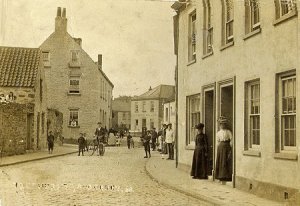
Riduna is set in the mid to late 19th Century and on the island of Riduna (Alderney) the role of single women was certainly to work in service or in the important tourist industry. They would be maids in the various larger homes or boarding houses or waitresses or cleaning staff in the few hotels. Travelling was important to the Victorians of means and destinations like Alderney provided a desired break from everyday life at home. (Nothing changes)

On Alderney the majority of children went to school, although the girls would have focussed on reading, writing and needlework. Only a few would have enjoyed a wider curriculum. It is interesting to me that my Great Grandmother, living on Alderney at the time, was literate, whereas her husband, a Guernseyman could barely sign his own name at the time of their marriage. By 16 year, all the girls would be employed to provide a meagre income to contribute to household expenses until they were married. Then they would have to give up work, unless they continued in the family business, whether in a shop such as a bakers or an inn or boarding house.

Added to the life of the islanders the population was swelled by various migrating groups which had an impact on the social dynamics of late 19th Century Alderney. Firstly there were professionals from mainland Britain….for example doctors and teachers who would bring their families with them and to a certain extent a different set of values. Aspirations of the daughter of an island doctor would differ from that of an island girl. A female teacher would have been a spinster with a vocation. What happened if she  was tempted to marry? How would the islanders react. Her attitude to the dilemma would be more considered and rational than that of a young island girl, but it would none the less give a conflict of emotion.

The other unsettling dimension to life on Alderney at that time was caused by the workers on the various Forts and defences on the islands. These included migrants from the UK, Ireland and even Italy; those moving to wherever there was work to make a living for their family, who would travel with them. Thus communities around the Crabby Bay area swelled and to a certain extent kept to themselves. Often they would educate their children at home and have their own churches. Mix between these groups and islanders was not always encouraged.

The other migrant workers of influence were the military. Wouldn’t the dashing red-coated soldiers turn the heads of many simple island girls? Wouldn’t their presence cause a stiffening of attitude from the island elders as they wished to protect the virtue of their young people?

The other major factor was the island itself. In a big city there is a certain amount of anonymity but on an island gossip abounds. One persons private business is known by the whole island within a very short time. Life on an island can be idyllic but it also can be claustrophobic, so much so that some dreamt of the wider world. Yet again there is a divide of the sexes here, because opportunities to leave the island were far more available for young men than girls, unless they married a visitor.

If you’d like to read more about these conflicts, my first novel ‘Riduna’ gives you a flavour of island life at that time. All these issues gave colour to the underlying storyline, adding a community dimension to the lives of the main characters Harriet and Edward.


Leave a comment

Filed under Alderney, Channel Islands, Historical Fiction, History of Alderney, Riduna

Virtual Tour Beyond the Solent no12 ~ Guernsey ~ The Isle of Flowers

Guernsey

After pausing on Alderney I continue my journey to significant places features in the Riduna series and Guernsey features in both Riduna and in Ancasta Guide me Swiftly Home.

In fact I knew of Guernsey long before Alderney and my first trip to Guernsey was at the age of seven.( I don’t count the visit when I was still just a twinkle in my mother’s eye, but I was there at minus two months so I’m told!) I have fond memories of this holiday, of walking along cliff top paths and down steep steps to secluded bays. I remember the boat trip from Fermaine to St Peter Port and getting about on busses, not to mention day trips to Herm and Sark.

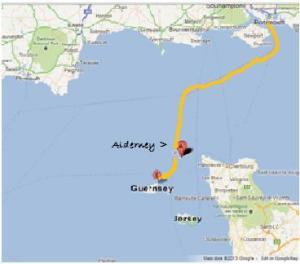
Back in the nineteenth and early twentieth centuries it was still more likely that travellers would visit Guernsey on their way through to Alderney and so that was my vision when I took a holiday over there to do some research back in 2002. I took the slow ferry from Portsmouth which took several hours, six I think, and then I spent many happy days researching in the museum and the Priaulx Library, fantastic places for anyone interested in the history of the islands.

I also borrowed many books about the island’s history from my local county archives at home and absorbed myself in the life and history of the times.

What interesting facts did I glean? It would be difficult to sum this up in one blog post but for Riduna it was the military presence with the Victorian fortification;the interesting rules of society, for example that an individual needed a formal invitiation to an island dance by a well respected local family; that the main trades at the time were importing tomatoes, stone and cattle, not to mention the tourist industry, which was vital for the island’s econony back then too. I was fascinated to read accounts of some of these visitors and one comment that struck a note was that the island’s poor seemed at least well fed, clothed and wore shoes. Whether this was true in the outlying villages I’m not so sure, but there seemed to be work during that period. All of these industries were labour intensive, even though the latter was, to a certain extent, seasonal.

What did I know from snippets passed down through my family? That they owned a small guest house; that my great grand mother could ‘dance on a sixpence’ and so she must have gained an invitation to the dances even though they were certainly not a well to do family; that my great grand mother from Alderney was literate but my great grandfather who was born on Guernsey was not;  that my great grandfather was a skilled gold leaf painter and he travelled to France for the pigment. All of these gems helped to weave the story of Riduna as Harriet, the leading lady was exiled from Alderney at 15yrs to stay with an aunt.
OLYMPUS DIGITAL CAMERA

The links with Guernsey did not stop at Riduna but continued to weave through the Ancasta too. It was on Guernsey (Sarnia) in my novel that Sarah, Harriet’s daughter was first made aware that her father had another life far away from Woolston, Southampton. Not only that but he also had a family of whom he rarely spoke. Here is a short extract from Ancasta:

“They strolled in companionable silence down the short cobbled slope of Well Road, between the rows of harbourmen’s cottages. The road narrowed and turned, the way ahead being covered with shadows, before suddenly emerging into the sunlight, with the harbour in front of them. Small boats mingled, chattering messages as they fidgeted against the glittering water. They dodged a Hansom Cab racing towards the jetty and joined the wave of people walking towards the waiting steamer to England. A few were carrying their own bags but most were following on the heels of one of the many barrow boys, who frequently turned their capped heads to smile or make some light-hearted and humorous comment to check that the owners of their burdens were not too far behind. Sarah heard glimpses of conversations: sad farewells, fond recollections of their stay on the island, exciting plans for future visits or the journey ahead as she tuned in and out between the channels of her own thoughts and the reality around her.

                Rose led Sarah to an area above the waiting ship, where wooden slatted seats were occupied by folks enjoying a rest or admiring the view. They found a place to sit beside an elderly couple with lined, contented faces, walking sticks leaning at their sides and wrinkled hands clasped together in eternal love and friendship. The couple beamed as the ladies joined them and it struck Sarah just how similar their features had become as they had aged together.

                Sarah sighed.

‘It’s difficult to explain. Suddenly I feel that I hardly knew my father at all. Here is a world, a place I have barely heard him speak of, the beautiful home of his birth and where he grew up; family, friends and a life I have very little knowledge or understanding of. It’s disconcerting, to say the least.’

                Rose thought for a few moments, wishing to give the right words of comfort to this confused young woman. The day had been a long one. That morning Joe Newton had been buried according to his wishes in a grave alongside his parents, far away from his home in England.

‘Your father was many people: father, husband, son, brother, cousin and friend. Each facet had its own character and its own life, just like a different scene in a play. In each scene he was a special man and lived to please the people around him whenever he could.’

‘I understand what you are saying. During the long journey here yesterday I had time to think. I was wracked with guilt that my father had come over here on a visit and died alone, so far away from his family. His heart attack had been so sudden. He was tired when he left but I never imagined he was ill.  I had visions of him being so far away from my mother and his children, just when he needed us most – but it wasn’t like that at all, was it?’

‘My poor girl! You must rest assured that he had his sister and many members of his family nearby. Also the nuns up at Les Cotils are very loving, caring people. He could not have been in better hands.’ 

There was another silence as they watched basket after basket of tomatoes and luggage hauled effortlessly on to the waiting ship and stowed securely by the stevedores, the line of laden carts queuing at the dock edge gradually dwindling.’

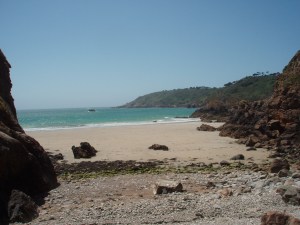
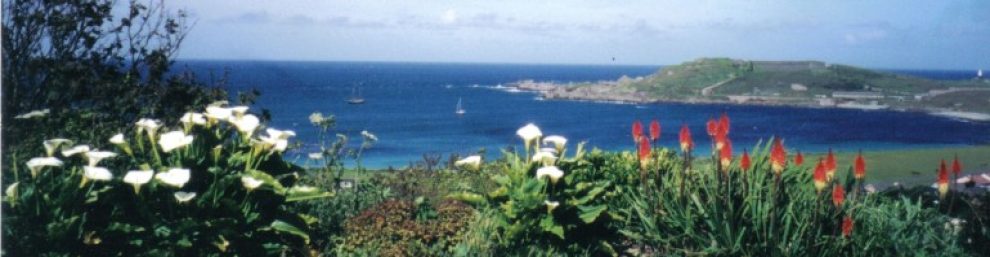
It was on this trip that Sarah’s love of the islands was ignited. Guernsey is an island of contrasts from the busy streets of St Peter Port to protected coves of Petit Bot Bay; from stunning clifftop walks to long open sandy bays; from busy restaurents to quiet cafes; from stately homes to little intimate museums, places to visit and of course the quaint shell church. Whereas I visit Alderney for quiet, that ‘I want to get away from it all moment,’ I visit Guernsey for a more lively retreat where I know I can also find hidden places to escape to.
Leave a comment

Filed under Alderney, Ancasta, Channel Islands, Riduna, Virtual Tour of the Solent and Beyond