Category Archives: History of Alderney

Part 1: Forward to Janus ~ Gateway to Heaven on Earth

This summer I am releasing my parents’ novella, originally called ‘Heaven on Earth’ Since it is the prequel to my first novel Riduna, I have returned to the romantic mythological title, calling it Janus, who was the Roman gateway to heaven on Earth.

Here is my parents’ Forward, which explains the original inspiration for their story:

“THE ISLAND OF Alderney, the third largest in the Channel Island group, was our family’s favourite holiday destination.

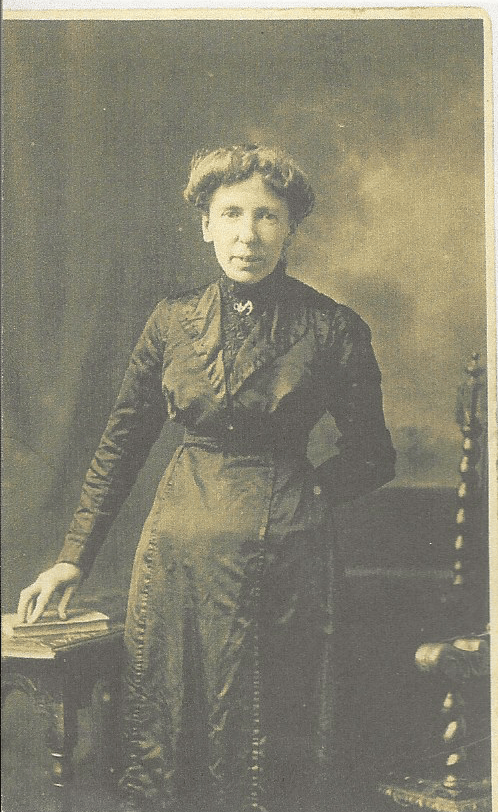
This is a story of life in Alderney, during the latter part of the 19th Century. It is about the members of our family who lived there. Our grandmother Harriet Hopkins was born on the island in 1871 and we now believe her family had lived there since 1600.

During our research we found a fairly extensive maritime record of Harriet’s father, Captain John Hopkins and that Harriet’s step-grandfather John Taylor, was a Scotsman who had been in the army. We decided to focus our tale on these two characters, although we changed the captain’s name to Harry to save confusion.

During the period covered in this story the island seems to have been a very happy place. Travel to the outside world was not easy and few of the Islanders ventured beyond the island shores. In contrast between that of the poor in London for example.

As for our grandmother’s life on Alderney we had very few facts. We discovered that Harriet’s grandparents were publicans from various census records and that they lived in ‘The Reading Rooms’ in Braye Road. Also, that John Taylor eventually married our great grandmother and farmed four acres.

With so little to go on this story is essentially fiction, constructed around available genealogical information. We have also adapted island customs, practices and folklore contained in island literature.

Part 2: Why have I decided to publish my parents’ novella? to follow next week.

Leave a comment

Filed under Alderney, Channel Islands, Family History, Historical Fiction, History of Alderney

Truth is Sometimes Stranger than Fiction ~ 1841 to 1880

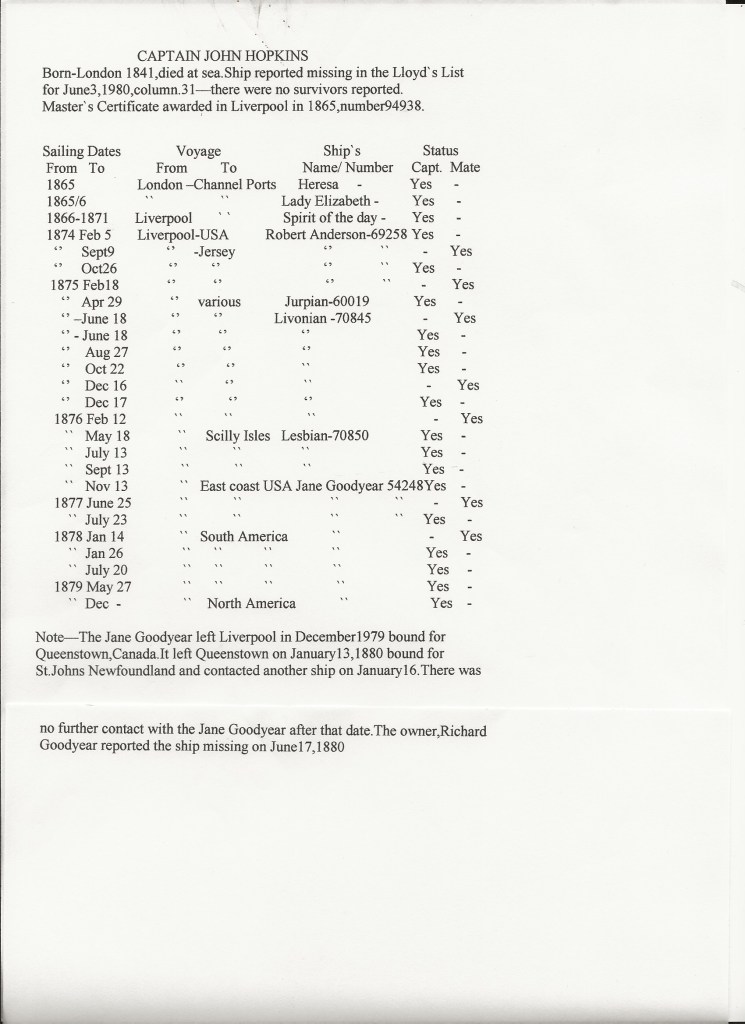
As explained in the previous post, Harriet‘s mother married a sea captain, John Hopkins, who my parents discovered was lost at sea on the Jane Goodyear in 1880, travelling to North America. Here’s his story in brief and then my parents summary of their visit to Liverpool to discover more details.

Captain John Hopkins Born in London in 1841

All of what we know about Captain John Hopkins was uncovered by my parents through a substantial amount of research on Alderney, in Southampton, London and in Liverpool. Here is a summary of their findings:

Account of “LIVERPOOL VISIT IN JUNE 2011” by Pat and Arthur Jackson

“Towards the end of the nineteenth century, Liverpool was a very busy port, which served ships plying the Atlantic to America. The port comprised a number of interconnected, square shaped areas of water, fed from and accessed from, the River Mersey. These are the Liverpool Docks, which are called Princess, Queens, Albert, Dukes, Canning, Salthouse and Wapping. Ships would berth along the four sides of each dock and if necessary, some would anchor in the middle. Paintings of the period in the Liverpool Maritime Museum, show the docks filled to capacity with ships. The docks were surrounded by large, brick built, warehouses, which handled the cargoes carried by the ships. The warehouses still exist and have been adapted for use as housing, offices and shops.

            With the coming of steam engines, ships became too large to pass through the dock entrance and the docks were too small for the ships to berth in. The old Liverpool Docks are still used for small craft and for pleasure activities and the dock area is now a tourist attraction.

            From about 1855 to 1866 John Hopkins served in ships sailing from the port of London to the Channel Islands and to the Channel Ports. He first served as a junior deck hand or ‘Nipper` on the Heresa and as he gained experience, he was promoted to deck hand. He studied hard and became Mate after he had passed the examination. In 1865 he passed the Captain’s examination and became Captain of the Heresa.

The next year the owners replaced the Heresa with a newer and larger ship called the Spirit of the Day and John was again given the captaincy.

 In August 1865, John married Jane Renier in Alderney and his new wife sailed with him on most of his later voyages.*

 With his career established, in 1866 John felt he needed experience of foreign travel and to do this he and Jane moved to Liverpool, he to command ships sailing from that port and where possible, for Jane to sail with him. Tragedy struck in January 1880 when their ship, the Jane Goodyear, was lost off the coast of Canada, near St Johns, Newfoundland. None of the crew survived.

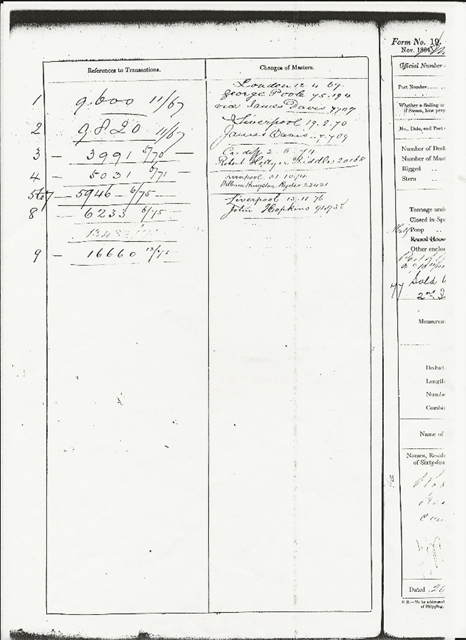
John Hopkins spent his last fourteen years living in Liverpool and serving on ships out of Liverpool, yet we know so little of this period of his life. We hoped that our visit to Liverpool would fill in some of the gaps and we were not disappointed. At Liverpool Maritime Museum we spent two hours with the Assistant Curator, John Winrow, who showed us original records, micro film and other documents in answer to the questions that we raised. The following notes summarize what we learnt:

Question 1-Could John Hopkins have been involved in the Slave Trade?

Answer-No, since slavery was abolished long before John started sailing from Liverpool

Question 2-were the voyages from Liverpool to the USA?

Answer-After the American War of Independence ended there was very little trade with the USA. Most ships traded with Canada.

Question3-Could piracy have been involved in the loss of the Jane Goodyear?

Answer-No. Piracy happened mainly in the West Indies and had almost stopped as a result of the efforts of the British Navy.

Question 4-What is known about the final voyage of the Jane Goodyear?

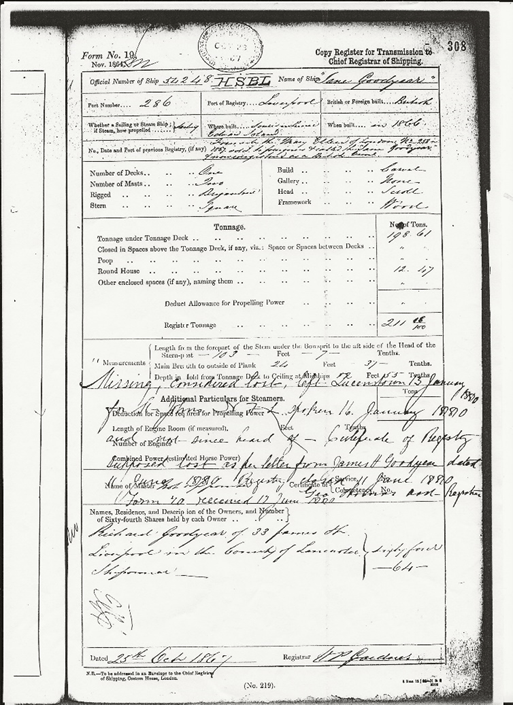
Answer-The ship left Liverpool in December 1879, bound for Canada and would have had to cross the north Atlantic in winter. It arrived at the small port of Queenstown, Canada early in January 1880. It left Queenstown on January 13, bound for St Johns, Newfoundland and was in contact with another ship on January 16 and was not heard of after that date. Lloyd`s List for June3 1880, column31 reported that the Jane Goodyear was presumed lost and a loss report was submitted by the owner Richard Goodyear.

Question5-What sort of ship was the Jane Goodyear?

Answer-She was built in1866 and was a single deck wooden ship with a scroll at the bows and two masts. It was103 feet long and 24 feet wide and had a carrying capacity of 211 tons. The ship probably had a crew of between 10 and 20.and would not normally carry passengers since the accommodation was very basic

Question6-What sort of cargo would have been carried on the ships John sailed in?

Answer-the ships would carry goods which had been ordered by customers at the port of destination and would bring back goods ordered in England. The only qualification was that the goods could be safely carried in the ship`s hold.

Question7-Sometimes there was a gap of many days or weeks between arriving back at Liverpool and starting the next voyage, where would the crew live for this period?

         Answer-The Captains were often very wealthy men and would own or rent a house in or near Liverpool, where they and their family lived. During the period July20,1878 and May27,1879 when John was not sailing in the Jane Goodyear, he lived across the Mersey at 6 Holt Road,Tranmere. The house has now been demolished as part of the Liverpool redevelopment.

When there was only a few days between arriving and departing the captain would often remain on board to supervise the unloading and loading of the cargo.

The crew were often local men with families in Liverpool.”

Pat and Arthur Jackson

The Jane Goodyear is missing ~ presumed lost at sea

  • Of course, it is now uncertain as to whether John Hopkins married Jane or Rachel. (See previous posts but I’ll add more if I discover the truth)
1 Comment

Filed under Alderney, Channel Islands, Family History, History of Alderney

In WW1 Victor returns injured to Riduna (Alderney) ~ the island of his birth

In Ancasta Guide me Swiftly Home I have tried to tell less well known tales of the Great War. Having said that, each of the Newton family from Woolston, Southampton played plausible roles in WW1 taking them as far as Turkey and even India. Here Victor, an injured soldier, returns to Riduna (Alderney) the island of his birth, to play his part in the ‘home guard.’ In order to support his family he also went fishing ~ for solace as well as sustenance – although it did not always achieve the peace he longed for: 

When Victor first returned to Riduna (Alderney) he could often be seen fishing on the rocky shoreline to the right of Fort Raz on Longy Bay, a lone silhouette of a figure standing statuesque off an outcrop not far from the sweeping sandy bay. In fact, at first glance he almost looked like a dark rock himself, protruding upright from the shore: a reflection of the Hanging Rock nearby.

Unfortunately, this familiar place where he had always loved to fish with his father and grandfather before him gave him no peace. The coast of France was clearly visible to him. Even with the sound of the sea, it was impossible to block out the echo of distant gunfire, fetching the true reality of the war right to the shoreline. There was no real way of escaping the horrors and the memories.

Instead he began to join the many young lads, fishing for mackerel and mullet off the Breakwater. He stood cheek by jowl, with just enough room to cast the twine into the sea from his long heavy pole. His younger brother William stood on the ledge behind him, attaching the bait and retrieving the captured mackerel, which Victor flicked expertly, as near to William as he could. Their catch was certainly adequate to fulfil the bodily needs of his family, although he still yearned to fish in solitude.

One afternoon he could bear it no more and so, instead of heading for the Breakwater, he began to clamber over the rocks by Fort Doyle. With his brother William holding the rod and bait, skipping lithely from rock to rock, Victor was embarrassed as he struggled and slid over the wet rocks, using both hands to steady himself as he coped with his painful shoulder and injured leg. Many times William looked back and wanted to give Victor support but in the end looked onwards, knowing full well that his older brother would be too proud to accept help. Finally they reached a ledge of rocks which jutted right out into the swirling waters and Victor settled there to gain his breath. William prepared the line for him, untangled the twine from the quill and cork float and attached some mackerel flesh to the hook as bait, carefully squeezing it between his thumb and forefinger. He handed the rod to his brother, knowing instinctively that Victor wanted to fish alone and then went to look for shrimps in the rock pools nearby.

                Before Victor cast the line he sat and looked around him. His eyes spanned between Fort Groznez to his right, standing with pride to defend the harbour and breakwater, to the imposing sight of Fort Tourgis to his left, and the long barracks sweeping down from the horizon towards the stony shores of Clonque Bay. Just across the sea from Fort Tourgis lay the deserted island of Burhou, with dangerous waters swirling around outcrops of rocks as far as the eye could see. As Victor’s eyes swept along the bay and out towards the open sea, he sighed with a rare moment of contentment. He cast his line and as he watched the float bob in the waters in front of him he began to relax. He breathed in the salty air, filling his lungs and clearing his mind. His thoughts drifted in and out of a pleasant emptiness.”

Ancasta Guide me Swiftly Home is Diana Jackson’s second novel, set between 1910 and 1920 telling the stories of members of the Newton family as they embark on their own role on The Great War.

Leave a comment

Filed under Alderney, Ancasta, Channel Islands, History of Alderney, The Great War, WW1