Tag Archives: Ancasta Guide me Swiftly Home

Virtual Tour of the Solent and Beyond ~No 14~WW1 in the Med and Port Said

If this is the first of my virtual tour posts that you’ve stumbles upon, since Christmas I’ve been on a journey around the Solent from Fort Gilkicker, along Southampton Water, back out to Calshot, over to The Channel Islands and France and today we travel in our mind’s eye to Turkey and the Mediterranean. This is the journey of Ancasta Guide me Swiftly Home, my second novel, and the destination of Harriet’s most adventurous son as he played his part in WW1.

It is the stories of Jack and his brother Tom which makes Ancasta such a unique story of WW1, but without giving too much away in today’s post I will explain the background to Jack’s tale. Jack was the lively son, full of a sense of humour and a need for adventure. (Tom was the quite, thoughtful one and Ernest the serious young man who took role as head of the family since his father died in earnest!) Mechanically minded Jack was never more at home than when he was working on engines. Apprenticed at White’s Boatyard as an engineer on the banks of the River Itchen, it was the most natural progression in the world for him to transfer to Calshot, where he maintained flying boats at the new RNAS station in 1913.

As war broke out he joined up and his story, told by letters back home to his loving wife Hannah, were of his excitement, joys and frustrations of working on one of the earliest sea plane carriers in WW1, The Ben my Chree, meaning ‘Lady of my Heart,’  which I thought such an apt double entendre. Was it his wife or his ship and the sea planes he so lovingly worked on who stole his heart? You, the reader, must decide.

Turkey was where the Ben my Chree contributed most to the war effort and this is where my novel describes real events through theSolent Google Maps Turkey Port Said eyes of Jack. My research, carried out mainly at the Shuttleworth Archives, of the Ben my Chree led me to visit The Fleet Air Arm Museum at RNAS  Yeovilton, where I was excited to see scale models of early sea plane carriers like the one Jack served on. (In fact, I was more enthusiastic than my husband, who was keen to see jets and planes of a more modern era which meant nothing to me!) Before doing this research I was unaware of the part sea plane carriers played in WW1 and I hope that my novel will prove to be informative as well as a good read.
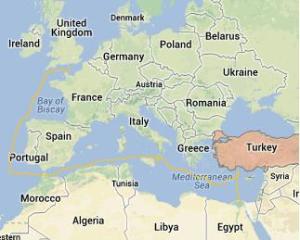
On a couple of occasions Jack’s ship docked in Port Said for repairs and supplies. I had vivid pictures of the port in my mind from early postcards my grandfather had collected of the area when he was in the Navy. I cannot share them with you today but hope to in the future.  Since reading Ancasta my father has told me a story of my family history of which I was totally unaware before writing the novel. I am bursting to tell you this but can’t, and if you’ve been following my journey into writing from the beginning it is certainly not the first strange coincidence to take place. What I can say is that my grandfather actually met his brother quite by chance in Post Said back in WW1, but I’m afraid I’ll just have to let you read the book before I tell you what really happened.

Back to my novel Ancasta Guide me Swiftly Home, what Hannah makes of these adventures as she is left at home with their young daughter waiting for news is the other side to my story of course. How did Jack and the pilot of his planes contribute to the war effort? Did the Ben my Chree survive the war? Did Jack return home?

All these questions I cannot answer. You’ll just have to wait and see, but if you’ve read Ancasta and want to know the true coincidence then drop me an email and I’d be happy to tell you!

diana@dianamaryjackson.co.uk
Leave a comment

Filed under Ancasta, Early Flight, Family History, Flying Boats and Sea Planes, Research, Virtual Tour of the Solent and Beyond, WW1

Virtual Tour of the Solent and Beyond~No 13~Over the English Channel to France in the Great War

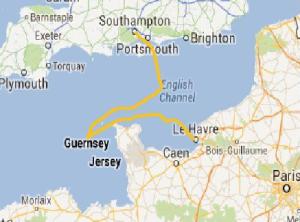
Over to France

Over to France

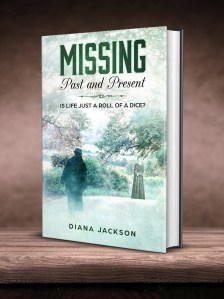
Ancasta Guide me Swiftly Home is set between 1910 and 1920 and so the members of the Newton family see many facets of World War One; the life changing experiences of the women at home in Woolston as Harriet opens her home for convalescent soldiers; the marked effect on their children and Jane’s world at The Royal Victoria Hospital. Life goes on as best it can.

There is a continuous flow of ships up and down Southampton Water, including Edward’s ship, commandeered to send new troops to France and to return full to the gunnels with the injured. Every home in every street is affected, when memories of the horror of the Titanic have barely had the chance to heal. Although Ancasta dwells more on those who remain in Woolston, France is never far from their minds, especially when Anthony, Harriet’s son-in-law is trained initially as an observer, on reconniassnace missions taking photographs of the area of conflict from the air. Then, having taken part in several successful fact finding missions he came home to fulifil his wish to complete his full pilot training.  

Thus Ancasta has chapters which tell Anthony’s story from his training at Gosport to his long journey to France, by ship to Le Havre and then by barge up the river to Rouen; the sights on this trip in sharp contrast to the ones he will witness shortly. We read of some of his  experiences in France through letters to his wife wife Sarah, who has moved back home to Woolston to live with her mother Harriet for the duration of the war. Through these extracts we learn of Anthony’s joy of learning to fly and we see the war on the home front through his eyes, not in the depths of the muddy fields of France but almost as a movie from above. It is nonetheless vivid in its devastation.

These chapters were inspired expecially by an old tome I borrowed from The Shuttleworth Archives called ‘Sagittarius Rising’ by Cecil Lewis, a gripping true account which reads more like a novel in itself.

Will Anthony be one of the lucky ones to return? What are the odds with my no 13 post on my virtual tour?

When you think of the sacrifice so many of these young men made for us all though, luck doesn’t really come into it, does it?

The name of the novel ‘Ancasta’ is even more pertinent during this period as the women prayed for the swift and safe return of their loved ones from France just as the Romans prayed to Ancasta, ‘The Swift One’ centuries before in this very location.

There are many websites and blogs related to The Great War but here is a link to one I follow:

Great War Photos

Leave a comment

Filed under Ancasta, Early Flight, Research, Role of Women, The Great War, Virtual Tour of the Solent and Beyond, Woolston, WW1

Virtual Tour beyond the Solent no 11 ~ Alderney and Competition!!!

On the way to Alderney

On the way to Alderney

To Alderney

There you are

As most people who know me realise, Alderney is my most favourite place in the world and it’s where my story began. The reason my virtual tour goes straight from Calshot to Alderney is because it is the closest Channel Island to the mainland, and the closest to France too! The easiest way to get thereis by their own Aurigny islander plane, unless you are a sailor with a yacht! (This might change though, since there are rumours of a more regular ferry service on its way)

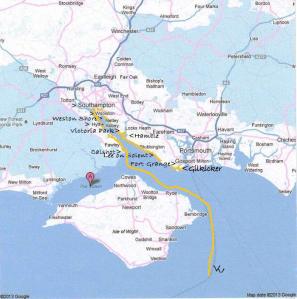
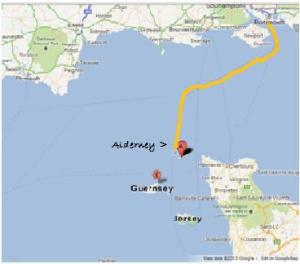
It was on Alderney where I made the decision to write my first novel ‘Riduna,’ allegedly the Roman name for the island, inspired by my Great Grandmother who was born there in the middle of the 19th Century. The ferries used to leave Southampton from what people now know as Ccean Village Marina opposite Woolston on the River Itchen and would have travelled past Weston Shore, the Royal Victoria Hospital and Calshot Castle before meeting the Solent. There they would almost certainly have headed east around the coast of the Isle of Wight and then on across the Channel. I travelled that route on the slow boat to Guernsey whilst doing my research, just to see want it was like. Today the ferry passes the island of Alderney just half an hour before reaching St Peter Port.

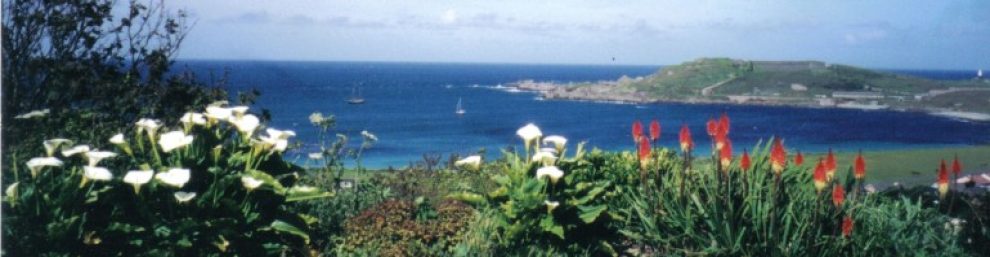
Why do I like Alderney, apart from my family history, and why do I keep a photo of Braye Beach in front of me on my desk? (the same photo which is at the top of this blog)

Firstly it is a very beautiful island, with long sandy bays and sheltered coves. There are abundant walks on which to view the wildlife. The island of Burhou, just off its coast, boasts of a colony of puffins, but there are also gannets on Gannet Rock, albino hedgehogs and black rabbits.  Although you may have heard that the Germans did their best to adorn the island with concrete defences, time has been kind and most are grassed over now or reclaimed. The underground defences still in existence adds a new meaning to the word ‘bunker’ on the golf course, I’m told, but since I know nothing about golf I can’t verify or deny the rumour. I do know that the views from the links are fantastic and there are benches where you can sit and admire them (as long as you keep your eye open for the odd stray golf ball!) There are imposing Victorian Fortresses which give quite an impact to the views as you stroll about, some on the island itself, some with tidal causeways and others totally cut off by the restless sea. You can’t help but admire the Victorian architects and builders who conceived them.

We also love to amble along the unspoilt cobbled streets of St Anne, lined with Georgian cottages and more sumptuous terraced houses and enjoy the wide variety of cafes and restaurants from local sea food to Thai, from fish and chips at the famous Braye Chippy to Pizza. The island just about caters for all tastes.

Now, this island has certainly inspired my writing and I call Alderney ~ ‘Riduna’ in my novels, The Riduna Series. I see Riduna as a character in itself, since feelings towards it run high. My characters either never want to leave her shores or they long to escape. For those who escape successfully, or have to move on against their free will, the island continues to drawn them home by its compelling force which seems to continue to hold sway over the next generation too. A bit like me really, two generations removed!

Well, I would really like to have some guest posts about Alderney for once I’ve finished my virtual tour ‘beyond.’

So:

~If you have any memories of holidays there, of humorous or cheerful tales. or of course of your childhood if you were lucky enough to be born there….

~If you have a special place that you would like to describe or trips or walks you enjoyed especially.

~If you’d like to put pen to paper and get in touch with me, then I have a small competition running.

The best two will win a £10 book token and a paperback copy of either Riduna or Ancasta

There will be an ebook or kindle version of Riduna for the first ten entrants too!

As long as you are happy for me to publish your post on this blog, with your name and any links you might like to use related to the island.

The closing date for this will be 12th April, when I have just returned from the island myself!

Get in touch for more details or just to send me your writing  in the body of the email please to:

diana@dianamaryjackson.co.uk

(up to 500 words but could be a poem of only 50!)

Leave a comment

Filed under Alderney, Ancasta, Channel Islands, Riduna, Virtual Tour of the Solent and Beyond