Seeking the Experts and Creating a Workable Structure
Once I had made the decision to set up a small publishing company in the autumn of 2011 I needed to carry out a great deal of research. I gleaned mountains of information from books, websites and writer’s magazines. In fact, many writers have written books about writing books,how to publish and how to market them or have organised seminars in the same vain. Some give excellent advice.
A. This is the approach I took:
1. Firstly I looked for an editor. Do I just go for an efficient proof reader or a copy editor who gives more feedback than a comma out of place or a repeated word I’d missed? (For the people who have been reading this blog and watching the progress of my writing you know that I had already spent a considerable time proof reading the manuscript myself. I had also given it to two friends whose knowledge of the English language is amazing and both can spot the rare error on the telegraph.) My advice here is to ask for several quotes and examples of their work, preferably on an extract of your own writing. Then check for reviews of the person, or company on the internet.
2. Secondly I needed to work with my cover designer. I had already chosen my cover designer. Colin van Geffen had helped me enormously in the historical content of the novel, and since he was a local artist to the Southampton area, he was the perfect choice. Yet again, I cannot stress more that you need to carry out your research. There are many companies on the internet who will do the work. Look at covers you admire of Indie authors. Ask the author themselves. Look at samples of the artists work on Amazon. I’m sure it is possible to do it yourself but it takes a great deal of skill and knowledge of the software package you are using. My advice here is get together with them, having a face to face discussion maybe in the pub with a table full of sketches and notes of ideas. This will hopefully avoid any confusion and misinterpretation caused by just a brief email.
3. Thirdly I looked for a typesetter. To have the finished book produced in a professional manner a good typesetter is also vital. (The person who formats the whole document, checking for font, margin and spacing consistency. This is quite a different skill to proof reading) Make your instructions clear at the outset. One issue with my original version of Riduna was font size which I had no say in when my first novel was published, and I always felt that the print was too small for many of my readership. This is especially an issue if your book is likely to be going into libraries.
4. Choose a printers. I wanted to choose a local printer, or one local to Southampton and the Channel Islands. There are many issues to think about here:
Quality ~ Ask for example copies of books, or buy a copy.
Price ~ Price may vary considerably and you need to decide between a print run or POD and being clear about page numbers is vital here
Fulfilment ~ My desire to support a local company (to me or my novel) in the end was outweighed by the decision that I wanted a company who could fulfil the orders for Eventispress too. If we printed them locally them we needed another company to store and fulfil the orders but neither could we afford added shipping costs. It was a balance.
I chose CPI in the end, because they are one of the major printing firms in the UK, printing both small and large print runs, as well as giving the option of POD at their branch in Eastbourne. (Since Riduna had been out since 2009 I was not sure whether a print run was appropriate and so this gave me another option.) Not only that, they have a fulfilment service too, keeping everything under the same roof, as it were. A gentleman was on the end of the phone or email in order to answer all my queries and to guide me through the process, liaising with my cover designer at the appropriate moment too. In fact Geoff Fisher acted like a mentor, patiently explaining things several times, until I was clear of the process and what was involved. In fact he did the typesetting in the end and formatted my books into e books, keeping everything ‘in house.’
5. Fulfilment Until I discovered CPI I looked into several options for fulfilment. What I did not want to get into was Eventispress being involved in the storage, packaging and postage and so the service CPI offer is ideal for us. Now that we have a system set up, it takes about twenty minutes, usually at about 7am to receive, acknowledge and forward the order on to CPI. Then, by mid morning I have an email by return to say that the books have been shipped first class. Excellent!
6. Wholesalers and Distributors
There could be a whole chapter on registering with Nielson Book Data UK, buying your ISBN numbers, recording your information on the Nielson’s hub, buying barcodes…….. but the exciting thing is that once you have registered your book with Nielson’s it appears automatically on Amazon, at Gardners and Bertrams (the two main book distributors in the UK). You become one of their Small Publishers and as long as you have an ISBN number, then orders will come directly through Nielson’s for your books. (At 5am I believe!) None of these processes are difficult, just time consuming as you get to know the systems. I eventually found it easier to work through Amazon directly but that’s another story too.
B. My main difficulties along the way:
Everything is time consuming, especially when you are getting to know the systems. This whole process has taken about a year to set up and we are still jumping hurdles and crawling through hoops, and sometimes it feels as if we are going backwards (or at least I would if I hadn’t got a back problem… I was hoovering last Thursday worrying about a difficult situation at work…yes I still teach three days per week and ping… I was on the floor crawling to the phone. You’d have thought that being off work might have given me more time but the opposite has occurred. I cannot sit comfortably for long and the medication is making me nod off to sleep at intervals!)
Getting the books to flow through the supply chain is a bit baffling and we are only just getting to grips with it. People are very helpful but you sometimes feel like a ping pong ball which hardly touches the table.
Unforeseen technical difficulties getting on to the internet in the summer (I gather it was actually a virus) and the telephone line going down at just the wrong time means that, although the launch was originally set for July, and rescheduled for September, the books are now available on Amazon but will still take time to order through shops. This is being sorted out. We aim to coincide this with the launch of my new website, which has been held up too and good news should be in the next few days!
Meanwhile my greatest frustration as a writer is that I have been able to do very little creative writing for a year. Although I have been working on a memoirs of a very dear old friend who has quite a story to tell!
If you go down this route you are bound to make mistakes while you are learning, but here are a few pointers of advice to help the process to go a bit more smoothly:
- Give plenty of time to check the supply chain well before launch – It’s vital (Add an extra month or two to your expected date to have a period of ‘can be pre ordered’ publicity!)
- Agree a discount with the wholesalers well in advance.
- Set up a careful system for tracking and numbering orders and invoices.
- Contact bookshops, museums etc only when you have a clear idea of what discount they would expect to receive to save time and money re-contacting them. Although a follow up call is always good courtesy.
- You need to realise that 60% is not an unreasonable discount for major bookshops and on line sellers such as Amazon to request when you are setting the original price. Remember, it is a balancing act because you are minnow competing with the whales of the publishing world.
If all of this is a bit daunting then there are many other easier ways of publishing (Six Ways to Publish Your Own Book), or you can just produce e books or you can return to countless submissions and eternal hopefulness, for which you need endless patience!
C. I have lots of good news though:
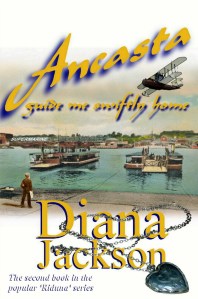
~ Ancasta Guide me Swiftly Home is now available on Amazon UK. If you order through Amazon Europe or America let me know how it goes. I’d love to know how long it takes and a picture sent to my email address
diana@dianamaryjackson.co.uk would be great
~I will be talking with Katie Martin on BBC Radio Solent in October… more news shortly!
~There will be a competition coming up for personally signed copies as Christmas presents!
~I aim to begin to write creatively again in October for the first time in a year!
~It will be easier next time!
It would be great to hear from you if you have any advice to add or have been through a similar experience…….
I am pleased to say that my next series of blogs returns to the books which inspired me while I was researching for ‘Ancasta’ starting with ‘Schneider Trophy to Spitfire’ by John Shelton, who I’m delighted to say contacted me recently!



 Diana Jackson