Category Archives: Research

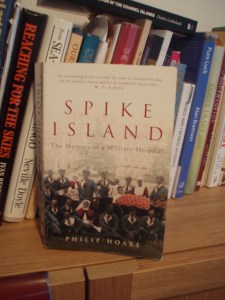
Spike Island by Philip Hoare ~ a personal book review

The Royal Victoria Hospital Netley

Thanks to ‘Spike Island’ by Philip Hoare, The Royal Victoria Hospital came alive for me and I could easily imagine some of my characters going there. I will not say in what fashion though.

The Royal Victoria Military Hospital in Netley must have been an astonishing sight to behold on entering Southampton Water from the Solent, with its corridors so long that ‘American GI’s drove Jeeps along them in WW2.’ Philip Hoare writes about the hospital, the largest in the world at that time, in a novel like prose, rather than in text book style. He describes the unexpected and somewhat off-putting main entrance, with its skeletons in endless display; the almost self contained life of the huge community who worked there, far more than just the nurses and patients; the nissan huts stretching as far the the back as the vast quarter of a mile long facade, seen impressively from the front.

I imagine an extremely proud queen, visiting the hospital on her return from holidays in her residence on the Isle of Wight, feeling satisfied as she alighted at the hospital’s own small wooden pier, gratified that a place had been created in her name to serve her Empire well.

Like with any research, only a fraction of Spike Island was relevant for Ancasta Guide me Swiftly Home, up to 1920 but, because it was written as a personal journey of discovery, it was fascinating throughout.

I had often seen the lonely building of the chapel, in the centre of the grounds of what is now known as The Royal Victoria Park, but in all my years of visiting family in Woolston as a child I do not ever remember visiting it and certainly had not realise that this chapel, standing in isolation, was once part of a truly magnificent monument to our greatness as a nation.

Today you can still enjoy visiting the chapel and visitors centre, or go one of the many planned walks in the area, which are steeped in interesting history, but without Philip Hoare’s insight, it would be impossible to imagine a fraction of what it might have been like to have been there.

Florence Nightingale was said to not have been very impressed with the building because, leading off those long corridors bathed in light with fantastic views across Southampton Water, were row upon row of wards. Since these wards were at the back of the building, they never saw the light of day and were dark and dreary places, not so welcoming to the thousands of patients who were treated there, returning wounded in body and soul from the Crimean War, WW1 and later WW2.
Leave a comment

Filed under Book reviews, Research, Southampton

Muse on Feminine Issues in Ancasta

You may be forgiven for thinking from reading my blog posts, that my novel Ancasta Guide me Swiftly Home is all about flying boats, the Hampshire Regiment, Palmerstone Forts and the Schneider Trophy. Yes they do feature, threaded through my story, but Ancasta addresses huge feminine issues of the time too.

Ancasta is actually a multi layered story of love and resilience, stressing the fortitude of women to adapt and sometimes take over men’s roles; in fact it is a story of how, with determination and strength of character women showed their worth at the time of World War 1 in a way rarely seen before, in British culture certainly.

My husband has gone to watch Speedway tonight and though I have promised to go with him once a year, an evening standing in a cold draft, watching little bikes race around a track is not my idea of fun on a Saturday night. Each to his or her own. This made me wonder why I have focussed on perceived to be masculine interests when promoting my new novel. (please forgive me if I’m being sexist or perpetuating stereotypes)

If someone had told me ten years ago that I would be reading non fiction on the Schneider Trophy and the Spitfire,  taking a lesson in fishing and getting excited on numerous air days, I would have laughed but I think it is because they are areas I really have had to work hard on, in order to research them thoroughly, so that I’ve become so absorbed.

I can only liken it to reading Shakespeare when I was about 14 yrs old. At first I didn’t really want to read it or try to understand it. I enjoyed going to see Romeo and Juliet at 15 and watching A Mid Summer Night’s Dream in Regent’s Park is still etched on my memory, but then I was lucky to have an inspiring teacher, Mrs Yates. It was she who made me look more carefully at the language and start to appreciate the beauty of it, but even now I admit to finding the Henry’s and Richard’s a bit challenging.

It’s the same with my research. It is meeting people who are fascinated by their subject, reading anecdotes and amusing stories as well as facts and experiencing live performances in places like Shuttleworth, which has made the subjects come alive for me, and also learning more about my family links with Supermarine.

So turning back to the women; I was inspired initially by my great grandmother who set up a guest house in Woolston and by reading about the magnitude of The Royal Victoria Hospital in Netley, not so long after Florence Nightingale opened the way for women nurses to travel the world. (In fact Florence was quite rude about the ‘magnificent’ hospital on the banks of Southampton Water)

We all know that women did a great deal of the work when their menfolk went off to war but what sort of work? I was particularly interested to note down any details and here are two examples.

I was talking to one of the mechanics in the Shuttleworth Air Museum in Biggleswade. (the chap turned out to be from the island of Sark, which was also a coincidence) I asked him about the wings of the aircraft and what they were made of and he explained how each aeroplane design had a unique pattern in the frayed fabric on the wings, and it was the women who stitched them so carefully during the war. This made sense to me but I was even more pleased to read in a book in the Bitterne Heritage Centre that some women were also taught to do the welding at Supermarine.

My women characters are strong. They have to be. Even before the war the reader will be aware of the tensions building up of the need for women to express themselves and for their opinions to count. As war progresses the women have no choice but to change, to run the home or a business, to work in a factory or become a nurse here in England, or in far distant places. The balance of relationships and responsibilities changes; it is tipped over and never really sees the same level again.

Leave a comment

Filed under Research, Role of Women, Supermarine

Journey into the Publishing World Part 1!

In my journey into writing I have discovered several ways to publish. People talk about Traditional Publishing versus Self Publishing, but I don’t see these as in competition with each other but offering alternative services. To many the Traditional route is a distant dream, worth striving for at all costs, but to others there are alternative ways, with unpredictable levels of success whichever way you choose:

THE TWO EXTREMES

1.  Find an established Publishing company who is willing to invest time and money on your writing (An extremely difficult thing to do these day)

2.  Self publish just as an e book with as low cost as possible asking family and friends to help you proof read (that’s fine if you are only really aiming to share with family and friends)

THE ONES IN BETWEEN

3. Publish through a company who may ask you for a contribution towards the costs. Each of these companies are offer different types of services. Some are up front and list the services you are paying for. Some just ask for a flat rate contribution. I would suggest, to avoid future confusion and possible disappointment whichever of these companies you choose, that you make sure you understand what you are paying for. These used to be called ‘Vanity Press.’ I dislike the term, but now I know more about the world of publishing I have a greater awareness of the role they play as publishers. Remember that some established publishing companies ask for author contributions for new, untested authors and the majority also expect début novelists to work hard to market their own work.

Acorn Independent Press for example gives you different levels of services to choose from depending on your needs

Amazon, through their Create Space will publish as an e book and paperback, without the same large

upfront charges

Some others worth checking out are AuthorHouse and Lightening Source  

YOUR OWN PUBLISHING COMPANY  

Make up your mind to set up your own company, buy in the services of experts to proof read, typeset, coverdesign and market your own novels and maybe those of others.

Here is the beginning of a three part story of how I did exactly that:

Part 1

I’m not sure whether it is reading ‘The Time of my Life’ by Ceceila Ahern, an author I have always admired which has led me to writing this post   (hence the title Honesty is the best policy!) or whether the fact that my page on ‘The Independent Author Network‘ has just been launched, or it could be having a clear out of all my correspondence with publishers in the last five years, the rejections, the vanity publishing contracts and proposals speaking gushingly about my writing and those tantalising notes, ‘you write well and we enjoyed the story  but its not for us at the moment.’ (I admit to keeping a couple of them!) The experts say take heart from any positive feedback and move on, which is what I did.

First of all I want to say thank you for Pegasus Elliot Mc Kenzie for giving me a start on this road towards ‘authordom’ and I will not go into my reasons for turning down their offer on another ‘partnership’ type of contract where they offered to publish my second novel ‘Ancasta Guide me Swiftly Home,’ but I do want to give the rationale behind Eventispress.

About two years ago I went to listen to a man who had not just self published but, instead of the ways I’d heard of, he had decided to set up his own publishing company. He talked of buying in professionals to help to produce and market his books and the whole idea excited me. As my bank manager said a year later, ‘It is as if you have been working towards this moment for ten years.’ At this talk I bought his book.(not the bank manager’s the speaker’s)

‘The Joy of Self Publishing’ by Mike Buchannan. (Mike writes about some pretty controversial subjects but I found the steps in this book very useful, reading it through twice from cover to cover.)

There are also a multitude of websites out there with advice. Personally, I think one of the best  is

Joel Friedlander’s ‘The Book Designer’

Also publications for example ‘The Writer’s Forum.’

With a great deal of soul searching and deliberation I decided that this was the route for me. Why?

I was inspired by the thought of producing a professional product and establishing a network for future writing projects. I already knew who I wanted to design the cover and had clear ideas including for example font size and a desired format.

What did I do next? Part 2 in this story will tell you about the research I carried out and decisions I took along the way. It was many more months after that when finally Eventispress was born.

Believe me, starting your own Publishing Company is not an easy option, as the Guardian reporter suggested, and so in the next post you will hear about the hurdles I’ve leapt over, and some crawled under on my belly along the way.

2 Comments

Filed under Marketing your novel, Publishing your novel, Research, Writing, Writing a novel