Category Archives: Frivolous Flying Facts

Amazing Female Aviators in the Early 20th Century ~ Harriet Quimby 1875-1912

Whilst researching for ‘Ancasta Guide me Swiftly Home’ I read a great deal about early aviators and was exciteded to read about Harriet Quimby, even though it had nothing to do with my novel. Anyone writing a novel knows how easy it is to get sidetracked and it led to me finding out about other female pioneers in aviation. After all, everyone has heard of Amy Johnson and Amelia Earhart from the 1930’s, but I was surprised to discover many women whose endeavours matched those male counterparts of their era as far back as 1910! Their daring to venture in what was seen as a man’s world accomplished much more than their achievements in flying alone, although these were certainly remarkable. They also designed clothes, opened factories, begun flying schools and fought prejudice at many levels. They were not, as I had imagined, all rich young ladies with plenty of time on their hands, but women who dared to be different.

I’d like to share this in posts over the next couple of weeks. If you enjoy my posts then please let your friends know and share it on twitter and facebook.

Harriet Quimby 1875 – 1912 ‘The Green Eyed Beauty’

Background and inspiration to fly ~ Harriet Quimby came from a poor American family, but by working herself up from journalism and theatrical writing she became a competent and successful screenwriter for the silent movies of her time. It was after attending the Belmont Park Air Tournament on Long Island that she decided she must learn to fly.

Aviation achievements ~ In 1911 she gained her pilots licence and became the first female American to gain an Aero Club of America Certificate. As many pilots of her day, Harriet gained experience and a way to fund her ambitions by participating in several air shows, but her main achievement was in April 1912 to be the first woman pilot to fly across the English Channel.

Death ~ Unfortunately she met her early death as a passenger in a two-seater Bleriot, only three months later in July 1912.

Notable difference ~ Harriet was also noted for her beauty and her dignified manner, but her other notable legacy was that she designed a suitable style of dress for women pilots of her day. She was known for her purple satin one piece flight suit which converted into pants (trousers) when flying but to a skirt when out of the aeroplane so that she did not offend the dress expectations of her era.

Harriet Quimby certainly moved the women’s movement forward in her own way and her fashion sense would amuse and please a friend of mine I visited recently who still keeps up to date with what is fashionable.
Leave a comment

Filed under Early Flight, Frivolous Flying Facts, Research, Role of Women

A Centenary Flight ~ Oldest British Plane to Fly

The Blackburn Monoplane 1912 to 2012

Last Sunday (7th October) there was a buzz at the Shuttleworth Air Day. Attendance to the show was high, the mood buoyant and we milled around with anticipation as we waited for the display to start.  I did a double take when several pipers, resplendent in their kilts, walked towards us but no, we were still in the heart of Bedfordshire and the Bedford Pipers were to perform for us. The sun shone and folks smiled.

The focus of the day was a Fast Jet Reunion and those watching were certainly not disappointed as the Folland Red Gnats did acrobats in the sky (Hey, I know where they were probably made…. we saw one outside Follands in Hamble near Southampton!) There were others including the Vampire Trainer (Can anyone tell me why it’s called a Vampire?)  and the Hawker Hunter. (1955) As well as the Jets there was the Hawker Demon, 1933, and the Hawker Hind, 1934. (My elderly 103 yr old friend Norman worked at Hawkers back in the 30’s so I felt a connection)

Then we arrived at the part of the show which truly interested me, the World War One planes. I have read about Tommy Sopwith and what a character he was, and then there was the SE5a which features in my novel ‘Ancasta.’ The sun was sinking fast but it was a still evening and so we were filled with hope that the old Edwardians would be able to fly. Our wait was rewarded with the Bristol Boxkite, (although I believe this is a replica) also featured in my novel and the Avro Triplane. I never tire of watching these priceless machines take to the skies.

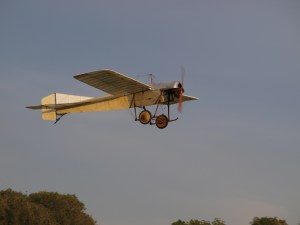
For me though, the climax of the day was watching the Blackburn Type D Monoplane, (Impressed… I copied this carefully from the programme) the oldest British plane which can still fly, take off on its 100th birthday. It first flew in December 1912 and Richard Shuttleworth found it in a barn of hay in 1937, before he bought it and had it restored. Thus, on Sunday The Shuttleworth Collection yet again treated us to a precious celebration of history come to life before our eyes!

As we were walking back through the remaining cars to go home I remarked on a lovely e type Jaguar.

‘That’s scary,’ my husband said. ‘You are recognising cars now.’

‘Oh,’ I said. ‘Do you know there are three things you’ve taught me since we’ve been together?’

‘What are those?’ he asked, puffing up proudly in a way only men can.

‘Cars, aeroplanes and how to swear!’ I replied.

Nevertheless it was another memorable flying day at Shuttleworth and as the announcer exclaimed at one point over the loud speaker,

‘We have to thank the RSPB for this unscheduled part of the show,’ as a flock of ducks flew in V formation overhead!

Leave a comment

Filed under Ancasta, Early Flight, Frivolous Flying Facts, The Shuttleworth Collection

Harriet Quimby ~ First woman to fly across the English Channel in 1912 ~ another 100yr old flying fact

I am just reading a biography of Jean Batten, one of the famous female world aviators of the early thirties and fascinating it is too, but it got me thinking about the pioneers in the era of my second novel, Ancasta (out very soon.) Although I have no women flying in my novel, I do have women whose roles in life change without recognition, due to their personal circumstances and also the aftermath of World War One.

Thus I was excited to discover Harriet Quimby, the first woman to fly over the English Channel, who did so as early as April 2012 and, since her birthday was in May, I think a blog to celebrate her life is appropriate.

An Amercian and already a screen writer of silent movies, she passed her  pilot’s test in August 1911 in the USA. The Wiki biography of her is brief, but it does say that she gained little media attention for her achievement, due to the devastating news of the sinking of the Titanic at the same time. Taking only 59minutes for the journey from Dover to Calais, I feel her achievement is all the more remarkable since it was a matter of only eight months after her success in gaining her pilot’s licence and she had travelled over the Atlantic for the successful attempt.

What strikes me about the characters of these early aviators is their single minded determination to break records or rise to the next challenge. Their challenges appeared to totally dominate every moment of their lives and, although each appeared to be ruthless, to the exclusion at times of others and any sense of a normal life, you could not help but admire them greatly!

I found a group who have already celebrated Harriet’s achievement, incidentally the namesake of my primary character in my novel Riduna, Women of Aviation, and so if you’d like to know more it is worth checking out.


Leave a comment

Filed under Early Flight, Frivolous Flying Facts