Category Archives: Family History

Diana Jackson’s Centenary Tour ~ October Events!

I’m excited to announce that my events to celebrate three centenaries continue this October.

RNAS Calshot March 1913

The First Schneider Trophy Contest April 1913

The birth of Supermarine in Woolston Southampton October 1913

I will be talking about my novels and my unusual interest in Supermarine and early flight, especially, flying boats and the role of women in WW1:

1. Thursday 3rd October 7pm

Waterstones Hitchin, Herts

 2. Saturday 5th October

Luton Book Festival 2013

11 am ’til  12 noon

Conference Room, Luton Town Centre Library

Then you can meet me, come and have a chat and even buy a signed copy of Ancasta for that special Christmas gift on

3. Saturday 12th October

Waterstones West Quay Southampton

11 am ’til 1 pm

I look forward to seeing you at one of these events!

If you’d like more details then please drop me a line diana@dianamaryjackson.co.uk

I’d love to hear from you.


2 Comments

Filed under Ancasta, Book reading, Events, Family History, Flying Boats and Sea Planes, Southampton

Virtual Tour of the Solent and Beyond ~No 14~WW1 in the Med and Port Said

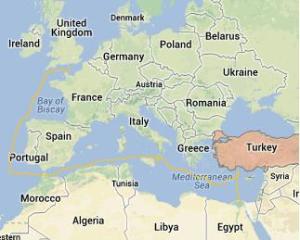
If this is the first of my virtual tour posts that you’ve stumbles upon, since Christmas I’ve been on a journey around the Solent from Fort Gilkicker, along Southampton Water, back out to Calshot, over to The Channel Islands and France and today we travel in our mind’s eye to Turkey and the Mediterranean. This is the journey of Ancasta Guide me Swiftly Home, my second novel, and the destination of Harriet’s most adventurous son as he played his part in WW1.

It is the stories of Jack and his brother Tom which makes Ancasta such a unique story of WW1, but without giving too much away in today’s post I will explain the background to Jack’s tale. Jack was the lively son, full of a sense of humour and a need for adventure. (Tom was the quite, thoughtful one and Ernest the serious young man who took role as head of the family since his father died in earnest!) Mechanically minded Jack was never more at home than when he was working on engines. Apprenticed at White’s Boatyard as an engineer on the banks of the River Itchen, it was the most natural progression in the world for him to transfer to Calshot, where he maintained flying boats at the new RNAS station in 1913.

As war broke out he joined up and his story, told by letters back home to his loving wife Hannah, were of his excitement, joys and frustrations of working on one of the earliest sea plane carriers in WW1, The Ben my Chree, meaning ‘Lady of my Heart,’  which I thought such an apt double entendre. Was it his wife or his ship and the sea planes he so lovingly worked on who stole his heart? You, the reader, must decide.

Turkey was where the Ben my Chree contributed most to the war effort and this is where my novel describes real events through theSolent Google Maps Turkey Port Said eyes of Jack. My research, carried out mainly at the Shuttleworth Archives, of the Ben my Chree led me to visit The Fleet Air Arm Museum at RNAS  Yeovilton, where I was excited to see scale models of early sea plane carriers like the one Jack served on. (In fact, I was more enthusiastic than my husband, who was keen to see jets and planes of a more modern era which meant nothing to me!) Before doing this research I was unaware of the part sea plane carriers played in WW1 and I hope that my novel will prove to be informative as well as a good read.

On a couple of occasions Jack’s ship docked in Port Said for repairs and supplies. I had vivid pictures of the port in my mind from early postcards my grandfather had collected of the area when he was in the Navy. I cannot share them with you today but hope to in the future.  Since reading Ancasta my father has told me a story of my family history of which I was totally unaware before writing the novel. I am bursting to tell you this but can’t, and if you’ve been following my journey into writing from the beginning it is certainly not the first strange coincidence to take place. What I can say is that my grandfather actually met his brother quite by chance in Post Said back in WW1, but I’m afraid I’ll just have to let you read the book before I tell you what really happened.

Back to my novel Ancasta Guide me Swiftly Home, what Hannah makes of these adventures as she is left at home with their young daughter waiting for news is the other side to my story of course. How did Jack and the pilot of his planes contribute to the war effort? Did the Ben my Chree survive the war? Did Jack return home?

All these questions I cannot answer. You’ll just have to wait and see, but if you’ve read Ancasta and want to know the true coincidence then drop me an email and I’d be happy to tell you!

diana@dianamaryjackson.co.uk

Leave a comment

Filed under Ancasta, Early Flight, Family History, Flying Boats and Sea Planes, Research, Virtual Tour of the Solent and Beyond, WW1

The Solent Area ~ Virtual Tour no 8 ~ Southampton

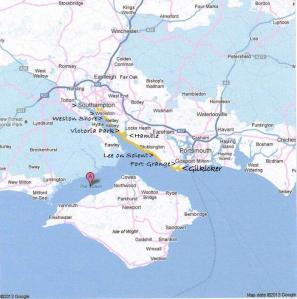
Solent map googleSouthampton

In the past, if  you’d taken the Floating Bridge over the River Itchen from Woolston then you would be close to Southampton Docks and as a child, when holidaying with my Grandma we used to do the round trip… over to Southampton via the Floating Bridge and back via Northam Bridge, or the other way around if that bus came first at the end of Newtown Road. A lady at my book launch at Woolston Library reminisced,

‘Wasn’t it irritating,’ she said, ‘that the bus always used to leave just as the Floating Bridge reached the shore!’ We all laughed sharing her memory.

Did you know that the Channel Island ferries used to leave from the docks at what we know as Ocean Village today, back in the nineteenth century?

To present old Southampton I am going to share with you another selection of Grandpa’s postcards, dated in the Edwardian era in the early years of the twentieth century. I can find no identical postcards on the internet and believe they do not hold any copyright due to their age.

Leaving the Floating Bridge we will first walk up Bridge Street where you can see the tram tracks:
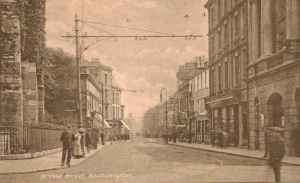
Bridge Street

Then we will head north to St Mary’s Road:
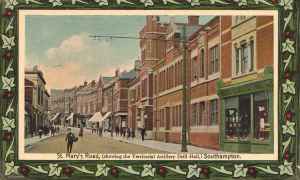
St Marys StreetFurther north of the city to Southampton Common and Lover’s Walk:
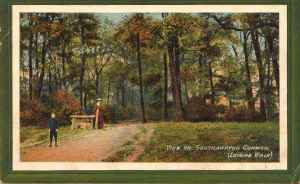
The Common Lover's WalkAlthough the walk to the common would be quite a long one in today’s terms, the people of those days thought nothing of such a walk on their half day off, to snatch moments with their loved ones and enjoy the fresh air. The Common saw famous air displays at that time too. If walking to the common was out of the question then Southampton also enjoyed Palmerstone Park close to the City centre:
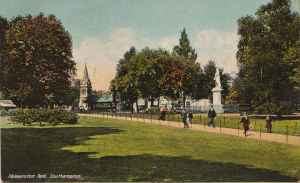
Palmerstone Park

Now we are back in the city, Tudor House museum has changed little and has recently been renovated. It is pleasant to have a stroll along the quieter back streets along the top of the wall:
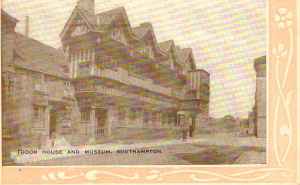
Tudor House

Out Grandfather had a shop near to the Bargate not far away, before they knocked part of the wall down for the tram route.
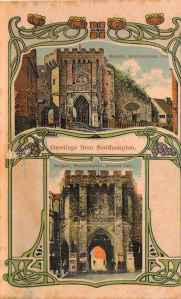
Bargate

Taking what my sister and i used to call the thirty nine steps when we were small you can walk down the wall. The shots below are still recogniseable although in front there is now a car-park and the West Quay Shopping Centre. This fascinating shot shows before and after the reclamation of the land to build the modern day docks, the first part of which was opened in 1842:
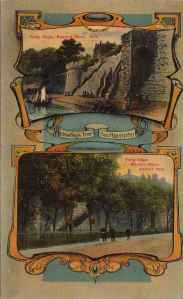
The wall

Following the wall along we are back down at the harbour and here is the South Western Hotel, recently converted into luxury flats and you can still see the structure of the docks railway station behind it although the busy streets in front take a while to cross, unlike the picture below:
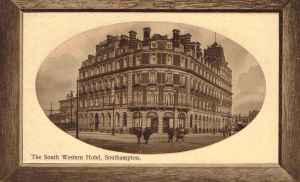
Western Hotel

And finally here is another ‘then and now’ postcard which shares so much of history with us in a snapshot, but of course the ‘now’ in this postcard is over 100 years ago!
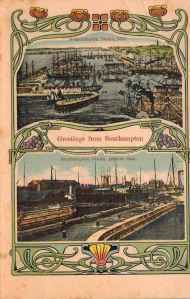
The docksAs one of the ladies on my last post of less common postcards of Old Woolston commented, these are a wonderful resource for research and ideas for writing. For me they are more than that. It’s just a pleasure to browse and wonder at the stories they tell and see places where my family lived and worked, but were also inspired enough to leave a trail behind.
Leave a comment

Filed under Family History, Research, Southampton, Virtual Tour of the Solent and Beyond, Woolston