Category Archives: Book reviews

What do I look for in Historical Fiction?

Image from the Historical Novel Society

If you follow the link above to the Historical Novel Society website they define the genre.

After last week’s contrasting book reviews I’ve been reflecting on what, to me, is great Historical Fiction.

What do others say?

10 Steps for Writing Historical Fiction by Krystal N. Craiker

How to write good Historical Fiction by Dave Chesson

What’s my take …

Initial Inspiration

There is usually a spark to any novel writing which lights the way. In historical fiction it is usually an era, person or an event in history.

Thorough Research

It is impossible to write Historical Fiction without a great deal of research and the way you keep notes is a vital process to making your novel writing run smoothly. The setting, way of life and man’s accomplishments; these peripheral areas of study which brings your eventual novel to life and gives it authenticity.

Expand your notes on detailed descriptions of your characters and the place in which they live.

Plan your novel

A linear time line of events is useful here. As you plot your novel then there will be gaps to fill. Make a strategy as to how you are going to span the years and be consistent in your approach. Will you bring in back story in snippets, as a prologue or afterward or just hint to it within your text?

Write the first draft

As you write you maybe aware of gaps in the plot or anomalies you hadn’t noticed before. Rather than stop the flow and go back to research you could keep a careful note of these issues. Also, I’m sure on rereading you, your beta readers or definitely your editor, will pick you up on an inconsistencies you have missed sometime in the future. The most important thing at this stage is adhering to your notes but also the flow of the story, to keep your readers interest on board.

Edit in stages

Unless they are a miracle worker, an author of historical fiction needs to reread the novel several times, maybe focussing of different areas:

consistency of facts,

flow of story,

descriptive and creative vocabulary,

Then send it to your beta- readers

and finally punctuation grammar and spelling.

Then send it to your editor.

Innovative Ideas

Like in art, for prizes in literature they seem to be looking for something new. I would like to think that judges might think twice and put the value of a ‘pleasurable’ read high up in their priorities.

What do you think?
Leave a comment

Filed under Book reading, Book reviews, Historical Fiction, Inspiration

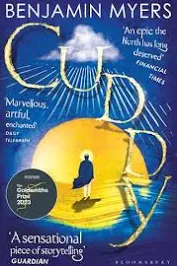
My June Reviews are a double ~ Matrix by Lauren Groff and Cuddy by Benjamin Myers

I picked both of these books up in Waterstones and was really looking forward to sinking into them last month and so here are my honest reviews.

Similarities

Matrix is set firmly in the 12th Century whereas Cuddy spans from St Cuthbert’s life and death in the 7th Century to the present, both books so long ago that I was excited about the conjecture and skill of each author to bring their extensive research alive.

Both were of religious orders under adversity. Cuddy’s monks fleeing the marauding Danes, to seek a safe resting place for the saint’s bones and in Matrix, Queen Eleanor sends her strange, ungainly and reluctant (to put it mildly) cousin Marie, to spend the rest of her life in an impoverished convent.

Both had themes, content and final chapters which made me sit up and feel uncomfortable, challenging my perceptions.

Both, from the blub and covers, had promise and Cuddy won the Goldsmith’s Prize in 2023 and so I picked that one up first.

Both books left an impression on me which was lasting.

Both books, I felt, were extremely well researched.

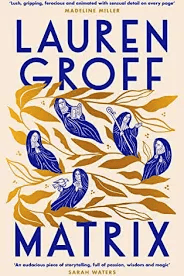
Matrix by Lauren Groff

I had so much empathy for Marie from the word go, although her sexual persuasions were personally challenging. Such a strong character who, through her personality and imposing physique, turned adversity into glory. By the time she died, the nuns under her protection were both as safe from the outside world as they could be, wanting for nothing, wealthy and on the whole content, each using skills to their own strength, to support each other as one combined unit. Marie, who had fought in the Crusades with her indomitable aunts, used this experience when facing jealous land owners, the church, and any dissent within her order. She battled all her life from within to become holy and live up to the position (originally unwanted) bestowed upon her, successful in varying degrees.

As I said, the ending made me sit up and challenged me even more than the content, but in summary it was an unputdownable novel, which I thoroughly enjoyed and quite a contrast to my review below.

Cuddy by Benjamin Myers

I apologize for the following, which many may disagree with, because I rarely say anything negative about a book, but the contrast in my personal reading experience of these two books was so great, that I felt compelled to share my views.

I struggled to read the first chapter. The unnecessary gaps, the long lists of acknowledgements within the text, the change of styles from conversation to prose, the change in font size and even layout.

I tried the second and third chapters, trying not to be deterred, since the cover had review quotes from major newspapers which gave nothing but glowing praise. I must be wrong I thought. It must be me!

By just after midway I gave up. It was too much of a struggle. A few days later I had the inspiration to read the final chapter. Lo and behold it was readable, enjoyable, I felt a warmth towards the characters and particularly towards Michael, who was suffering so much. I loved the way he was drawn to Durham cathedral and am a great believer that if you allow your fate to be pulled by powers beyond your control, then you find yourself where you are meant to be. Then I was devastated by the last paragraph, which left me uncomfortable and longing to know that Michael made something of his life and was able to overcome such a step. I like to think that Cuddy was now there with him to help him. My only self imposed consolation.

After finishing the book I turned to Amazon reviews, which I rarely do, to see why there are so many positive reviews. Maybe it was me. Scrolling down to the 3, 2 and 1 star reviews, I was filled with relief that so many people felt the same.

On reflection, I felt that Benjamin Myers had taken a very difficult subject, done his research thoroughly, but put together the book itself too quickly. Instead of crafting a readable tale for each chapter, drawing you on to the present day with each page, he left the manuscript at the ‘notes’ stage of development, full of thoughts, snippets of conversation, prose and lists of sources. Am I allowed to say that maybe it’s a ‘man thing’? Maybe Benjamin Myers finds it really hard to take his research and build a credible story. Is it a fact v fiction issue? I don’t know. Many of these reviews said his other books are great so I’ll try one of them to see.

Or, maybe it is me after all and I’m old fashioned. I just love, as I said at the beginning of this post, to sink into and enjoy a good yarn!

Leave a comment

Filed under Book reading, Book reviews, Inspiration

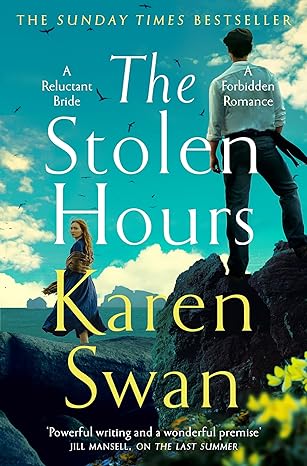
Diana’s May Review ~ The Stolen Hours by Karen Swan

This is the second of Karen Swan’s novels set on St Kilda at the time of the evacuation, each from the point of view of one of the island girls. This time it is Mhairi Mac Kinnon who is in need of a husband and she is whisked of to the nearby island of Harris to look.

As you can imagine there are twists and turns as the islanders prepare for evacuation and life doesn’t quite turn out as expected for Mhairi. Add potential murder to the plot and it is quite a read, all the more special by its location on the remote island in the outer Hebrides.

I’ve really enjoyed immersing myself in both of these books, where the island has a character of its own.

Leave a comment

Filed under Book reading, Book reviews, Scotland, Scottish authors